
Introduction
Who is Karol Wojtyła, or Pope John Paul II? I believe one could say he was the ultimate “headliner” of the century, breaking all records of popularity. It was this trait that was certainly the most evident during his papacy. With a huge crowd at every step, he was showered with hosannas and hallelujahs. These exaggerations seem to me to be a misuse of adoration, as if he were a superstar. supergod, Ayatollah, etc. …
Thus, he couldn’t do anything but evoke wonder as a Pope, in whatever situation he was in, be it as he spoke or observed, laid his hand on someone, greeted the people as a leader, wore his cassock, skied skillfully down mountains, indeed, one could even say on slippery slopes; wearing his mountaineering hat while climbing mountains and singing profane songs. He was a complex and poetic Pope, said to have had a melodramatic style and theatrical tendencies. However, he was always swimming against the current with his unrelenting aversion to conform to the traditionally accepted behavior of a man of the cloth. It was with this behavior that he destroyed the magnificence of Papal general audiences, with his singing and dancing, even in public, mingling with crowds from every continent, and exchanging the usual religious solitude of old with his personal participation in the every day life of man. Of course, this is only one aspect of his papacy. However, as written by Gianni Baget Bozzo, «This mass spectacle does not benefit anyone or anything. The constant travels, the multiplicity of speeches, seem to cover a substantial stagnation, and the Pope is increasingly seen as the author of a gradual restoration with a human face.»So you might say he was a “seducer,” but certainly not in the same meaning as was Christ!Many only praised Wojtyla. However many others distanced themselves from his actions, that were veiled in shadows, so as to leave one perplexed, such as his inability to distinguish between what is a Dogma of Faith and what is, instead, a historical contingency. He is a Pope whose beatification was challenged; a Pope who, according to Hans King, is the most contradictory of the twentieth century, a Pope whose inter-faith “Dialogue” permitted him to enter a mosque and persuaded him to open the door to other religions, a Pope who brought together Jews and Catholics and even went to witness the prayer of forgiveness at the “Wailing Wall,” etc. …Because of this, many saw him as a “reformer,” a “restorer,” not seeing that, instead, Wojtyla, little by little, was betraying the Catholic tradition, following the advice of heathen collaborators trademarked as modernists and progressives. And here he excommunicated the Traditional Archbishop Lefebvre, heedless of what Saint Paul said: «If even an Angel impose another Gospel other than that which He preached, it should not be obeyed.» However, why weren’t the more shameless and unscrupulous ecclesiastical rebels against Christ who wrote and approved heretical Catechisms ever punished or excommunicated? Why did he leave the Chairs of Catholic universities and seminaries, to theologians who denied the Divinity of Christ, who muddled Holy Scripture, who denied the virginity of The Blessed Virgin Mary and who taught many other heresies? Why did he sign Concordats that no longer protect the Church, the Catholic religion, Christian values? – Concordats that put all religions on an equal footing so as to allow countries to be called “atheist” states?And what of his “heresy of Assisi,” that “community prayer,” represented by all false religions, thus removing the Primacy of the Catholic Church, the Apostolic, Roman, Mother and Teacher of all souls and endangering the missionaries in their evangelization of the people, who today cannot, for all intents and purposes, defend the Catholic religion because it was put on the same level with the other religions that were recognized as having the same values of faith?And was it not perhaps also a grievous concern that he visited the “Synagogue” and the “Lutheran church?” Are not the Jews still determined to NOT recognize Jesus Christ as God and Messiah? Maybe they are no longer persecuting the Church of Christ? Perhaps Jesus was not always severe with them, or did not even converse with them? Maybe Jesus did not say «Whoever is not with Me is against Me? »There was also serious error in giving permission to the various Bishops to administer Communion in the hand, thus allowing a serious desecration of the Holy Eucharist, and also stripping away the due respect given to the Holy Eucharist, this respect that many popes had tried to increase over all of the past centuries of Church! After this outline of John Paul II, Pope and man, and on the principles of his pontificate, it must be admitted that he, on his death, has left a legacy to the Roman Catholic Church: a Church certainly much changed from that with which he had been entrusted with on October 16, 1978.Clearly, then, John Paul II was opposed to the “past” Tradition of the Church, and the work done by his predecessors. In other words, he worked in reverse to turn the permanence of the papal throne into a mobile home, travelling from one end of the world to other. It becomes necessary to ask oneself, therefore, whether it is possible to imagine a “different” Wojtyla, that is one who was not constantly center stage in the media, hailed by crowds from America, Africa, Asia, old Europe and from his home country, Poland itself. From any place on earth, all were able to see him, up close, through the powerful zoom of satellite TV, the gestures of his hands, the hardness in his eyes, his tense face, hisrare and elusive smile, the tremor of Parkinson’s disease, the patient and his convalescence at the window of the hospital, the grand gestures, ecumenical, inter-religious, and pacifistic in nature, the “mea culpa” of March 12, 2000, or the visit to the “Wailing Wall,” etc.His papacy was long and so contradictory that, knowing this, we gave our attention to a diverse number of “cases” that exposes, in all truth, the other Wojtyla.
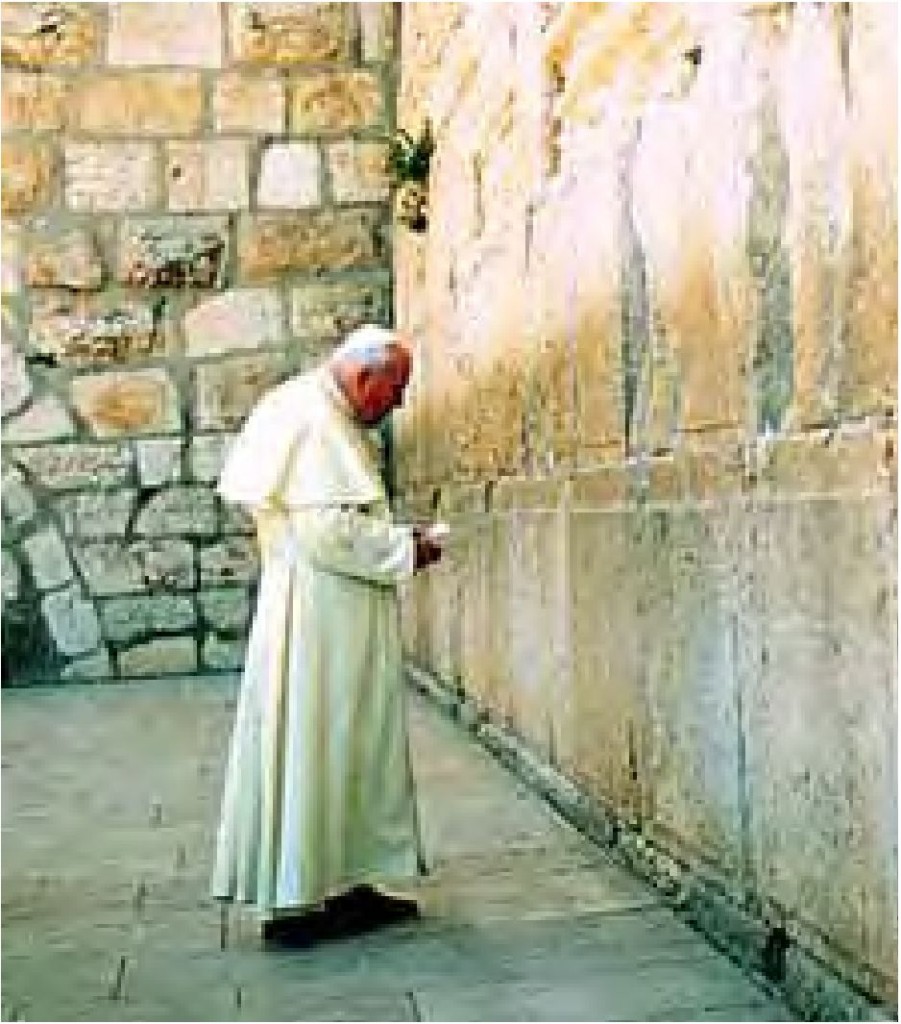
Gazeta Warszawska Villa 28John Paul II at the “Wailing Wall,” placing a sheet of paper with a prayer of forgiveness for past wrongs of the Church against the Jews in a crack in the Wall.
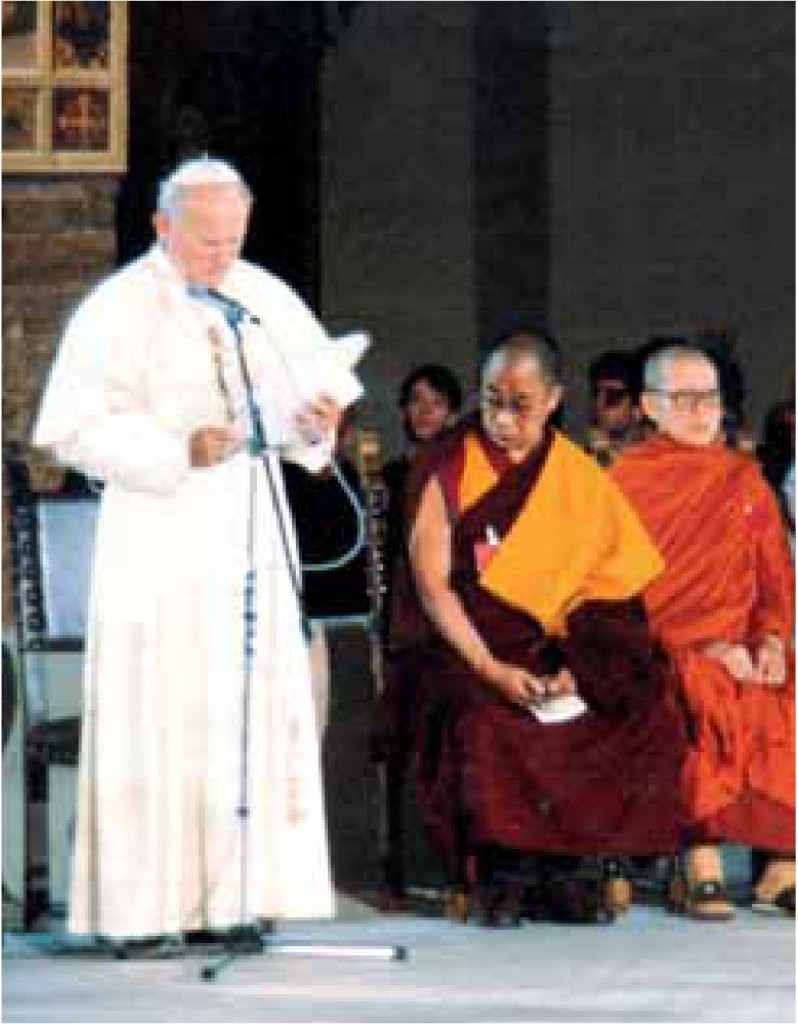
Gazeta Warszawska Villa 27At the meeting of inter-religious prayer in Assisi in 1986, John Paul II prevented the statue of Our Lady of Fatima to enter the Basilica so as not to “offend” other religions, and allowed a statue of Buddha to be placed on the tabernacle containing Our Lord Jesus Christ.
His Holiness John Paul II
– Biography Pre-Pontificate –

Gazeta Warszawska Villa 26
The little Karol Wojtyla with his mother, Emilia and father, Karol.
THE FAMILYHis father, Karol Wojtyla, the son of Maciej, master tailor, and Anna, was born July 18, 1879 at Lipnik near the town of Bielsko Biala. A tailor by profession, he became a non-commissioned officer in the Austrian army in 1900, and then lieutenant in the Polish army until his retirement in 1927.His mother Emilia Kaczorowska, daughter of Felix who was an artisan and Mary Anne, was born March 26, 1884. His brother Edmund, born August 27, 1906 in Krakow; was a doctor in a hospital in Bielsko Powszechny.KAROL JOZEF WOJTYLA1920 (May 18) Born in Wadowice (Krakow), Poland.(June 20) Baptized by the military chaplain, Fr Franciszek Zak. He lived with his parents in Wadowice, at Rynek 2 (now Via Koscielna 7, ext. 4).
1926 (September 15) Attended the elementary school, and then the prep school “Marcin Wadowita.” Throughout his studies he achieved top grades.
1929 (April 13) The death of his mother.
1930 (June) Admitted to the State Secondary School, “Marcin Wadowita.”
1932 (December 5) The death of his brother, Edmund.
1933 (June 14) Finished High school.
1934 (1934-1938) His first theatrical performances in Wadowice. During school, he was president of the Society of Mary. This same period marks his first pilgrimage to Czestochowa.
1935 (September) Participated in the military training exercises at Hermanice.(December 14) Was accepted into the Society of Mary
1938 (May) Received the Sacrament of Confirmation. (May 14) Final exam.(June 22) Applied for admission to the Faculty of Philosophy (Polish course) of the Jagellonian University in Krakow.(Summer) Moved, with his father, to Kraków (Via Tyniecka 10).(Academic Year 1938-39) While studying at the University, he joined “Studio 38,” a theater group founded by Tadeusz Kudliński.1939 (February 6) Entered the Student Society at the Jag- ellonian University (Eucharistic and charitable division). (July) The social formation of the Legion at the University Ozomla at Sadowa Wiszna, for Polish and Ukrainian students. (September 1) World War II broke out. (November 2) Enrolled in the second year course for Literature and Philosophy.1940 (February) Met Jan Tyranowski, a tailor, and a man of deep spirituality, who was educated at the Carmelite School. He introduced Wojtyla to the writings of John of the Cross and Teresa of Avila. This period marks the beginning of the underground theater directed by Tadeusz Kudliński. (November 1) Was employed as a carpenter in the stone quarries in Zakrzówek, near Krakow, thus escaping deportation and forced labor in the German Third Reich.1941 (February 18) The death of his father.(August) Welcomed home the family of Mieczyslaw Kotlarczyk, founder of the Theater of the Living Word (Rapsodyczny).(November 1) First theatrical play of Król Duch (Royal spirits), Juliusz Slowacki.
Gazeta Warszawska Villa 25
Karol Wojtyla 18 years old.
The first performances date from 1934-38. From 1940, Karol was a part of the underground theater of Tadeusz Kudliński.
Gazeta Warszawska Villa 24The young Karol with his friend Hania: a quasi-engagement.
1941 (February 18) Began working as a carpenter in a quarry, thanks to the solicitude of his trusted friend and French teacher, Jadwiga Lawaj, who, in turn, was a friend of Henryk Kulakowski, President of the Polish division of the Solvay empire.1942 (Spring) Was transferred from the quarry to the Solvay factory and was provided with, apart from salary, residential housing equipped with a doctor, library, and gym plus the guarantee to ride out the war unscathed. (October) Began to attend clandestine classes of the Faculty of Theology of the Jagellonian University as a seminarian of the Archdiocese of Krakow.1943 (March) Played the leading role for the premiere of “Samuel Zborowski” by Juliusz Slowacki. It was his last appearance on the stage (these “underground” performances took place in the homes of his group of friends).Gazeta Warszawska Villa 23

The young actress, Halina, who recited with the young Karol.
(Academic year 1943-44) Marked the second year of theological studies. Continued his work at Solvay.
1944 (February 29-March 12) Was hit by car, and hospitalized for his injuries.(August) Archbishop Adam Stefan Sapieha transferred him, along with other clandestine seminarians (illegal), to the Palace of the Archbishop. He remained there until the end of the war and continued with his studies. During this time he discontinued contact with Solvay.(November 9) He received the tonsure.(December 17) Took the first two minor holy orders.

1945 (January 18) The Red Army liberated Krakow from the Nazis. (Academic Year 1944-1945) Marked his third year of studies in the Theological Faculty of the Jagiel- lonian University. (April 9) Was elected vice-president of the student body “Bratnia Pomoc” (Fraternal Aid) of the Jagiel- lonian University and retained this post until May 1946. (Academic Year 1945-1946) Fourth year of theological studies. (December 12) Took the other two minor holy orders.
1946 (October 13) Became a subdeacon.(October 20) Became a deacon.(November 1) Was ordained a priest. As in previous occasions, he received Holy Orders from the hands of Archbishop Metropolitan Adam Sapieha in his private chapel.(November 2) Celebrated the Poor Souls in the crypt of St. Leonard in Wawel.(November 15) Continued his studies in Rome. (November 26) He enrolled at the Angelicum. (November 15-end December) Stayed at the Pallot- tines in Via Pettinari, Rome.(Last December) Together with Don Starowieyski, he stayed at the Pontifical Belgian College in Via Quirinale 26.

1947 (July 3) Passed the exam to earn him a Diploma in Theology. (Summer) Again with Fr. Starowieyski, he took a trip to France, Belgium and Holland. Near Charleroi he carried out pastoral work among the Polish workers.
Gazeta Warszawska Villa 22Actress Ginka and Karol as young actors. In Jerusalem, John Paul II had a poignant meeting with her and with her Jewish friend, Jerzy Kluger, his former rival in friendship for Ginka Beer.
Gazeta Warszawska Villa 21Karol Wojtyla became a priest in 1946.
1948 (June 14) Took the admission examination for his Ph.D. Cardinal Sapieha sent him to Rome to continue his studies at the Angelicum. But there was, at that time, as Rector of the university, the great theologian and writer Father Garrigou-Lagrange, who was a giant on Thomism. Wojtyla, not being a member of that teaching, was following the philosophy that he wanted, that of existentialism, the modern type of Kant. Therefore, his dissertation, “Faith according to St. John of the Cross,” was criticized and rejected by Lagrange, because it supported the ideas of the Modernists who claimed that Faith is based on personal experience. For this, Wojtyla was not accepted for the doctorate and he had to return to the University of Krakow, where there he was accepted.1950 He started his publications.
1951 (September 1, up to 1953) Archbishop Baziak put him on leave so that he could prepare himself for the qualifying exam to become a university professor. Up to this point he had only provided pastoral care for university students (in St. Florian) and for Health employees.
Gazeta Warszawska Villa 20Father Karol with a group of university students, in 1951.
Gazeta Warszawska Villa 19Father Karol at Romanko, July 1953, with his boys and girls.
Gazeta Warszawska Villa 18Zakopane, April 1953. Father Karol (center) after skiing with friends. Their passion was skiing at night with full moon.
1953 (From October) Taught “Catholic Social Ethics” for the Theological Faculty at the Jagellonian University.(December 1) Had his interview for professorship qualification.(December 3) Conference of professorship qualification, with given approval of the thesis “Evaluation of the possibility to build Christian ethics using, as a foundation, the system created by Max Scheler.”
1954 After the faculty of theology at the Jagellonian University had been abolished, a theological faculty was organized at the seminary of Krakow, where he continued teaching, also teaching at the Catholic University of Lublin as a lecturer.
Gazeta Warszawska Villa 17Park Oikow. Father Karo lshared his tent and his kayak trips with his students.
Gazeta Warszawska Villa 16Karol teacher, vicar and writer.
1956 (From December 1) Became the official substitute professor and employee of the Catholic University of Lublin.1957 (November 15) The Central Commission of Qualification approved his appointment as a free lecturer.
1958 (July 4) Appointed Auxiliary Bishop of Archbishop of Krakow, Mons. Eugeniusz Baziak.(September 28) Ordained Bishop in the Cathedral of Wavel.1960 (January) Karol Wojtyla’s dissertation for his teaching qualification was published by the Society of Sciences (Towarzyst Wojtyla Naukowe) at the Catholic University of Lublin: “Evaluation of the possibility to build Christian ethics using, as a foundation, the system created by Max Scheler.”(During the year) First edition of “Love and Responsibility” (ed. by TNKUL).
1962 (April 15) Was co-opted in the Episcopal Commission for Education. (July 16) After the death of Baziak he was elected Vicar of the Chapter.
Gazeta Warszawska Villa 15On July 4, 1958, Father Karol was appointed Auxiliary Bishop of Krakow by Archbishop Monsignor E. Baziak, his great defender.
Gazeta Warszawska Villa 14Msgr. Baziak died, June 15, 1962, after nearly two years of clashes between Card. Wyszynski, and the President of the Polish Parliament, Zenon Kliszko, the main ideologue of the Communist Party. Card. Wyszynski did not want Wojtyla as Archbishop of Krakow. However, in January 1964, under Pope Paul VI, Wojtyla was elected Archbishop of Krakow. After vetoing seven other names, Zenon Kliszko, had made it clear that he only approved of Wojtyla as Archbishop of Krakow.
Gazeta Warszawska Villa 13

(October 5) Participated in the work of Vatican II, the First Session (October 11 to December 8).
1963 (October 6 to December 4) Participated in the work of the Second Session of Vatican II.(December 5-15) Made a pilgrimage to the Holy Land with some bishops of different nationalities that were present at the Council.(December 30) Was appointed Archbishop of Krakow with the approval of Communist ideologist and President of the Polish Parliament, Zenon Kliszko.
1964 (January 13) Date of the papal seal that appointed him Archbishop of Krakow.(March 8) Officially established in the Wavel Cathedral. (September 10) Third Session of Vatican II (14 September-21 November). At the conclusion of this session he made a pilgrimage to the Holy Land, remaining there two weeks.
Gazeta Warszawska Villa 12

After a hike, Archbishop Wojtyla rests in shorts and a red scarf on his head.
Gazeta Warszawska Villa 11While Card. Wyszynsky could not get away from his diocese, because the communist government would not grant him permission, Archbishop Wojtyla had full freedom to travel abroad without restriction. This was the common policy of encouraging Wojtyla and destroying the old Cardinal Wyszynski for his anti-communism.
Gazeta Warszawska Villa 10
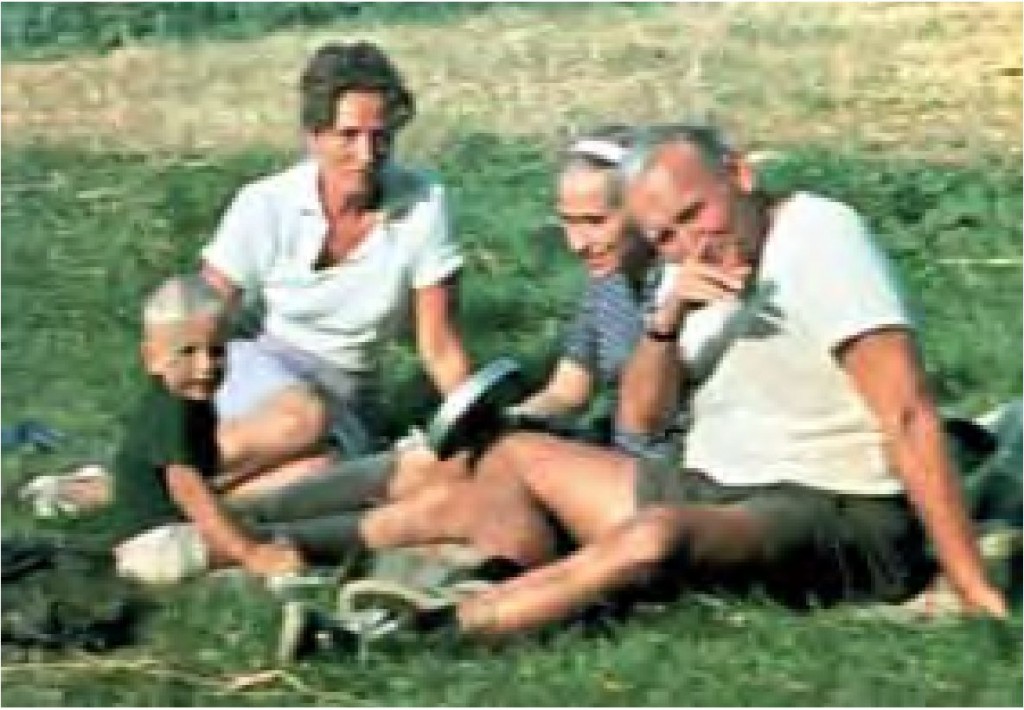
Archbishop Karol, in shorts and T-shirt, during a picnic with women and child.
Gazeta Warszawska Villa 9Card. Wojtyla in shorts and T-shirts, accompanied by a young woman with child and family, near Krakow.
1965 (January 31 to April 6) He participated in the work on the thirteenth draft of “Gaudium et spes” on the Church in the contemporary world (January 31st to February 6th in Ariccia, February 8th to 13th in Rome, and again in Rome from March 29th to April 6th). (September 14 to December 8) Fourth session and conclusion of the Vatican II Council.(November 18) Letter of Reconciliation of the Polish Bishops to the German bishops, containing the famous words: “We forgive and ask forgiveness.”
1966 (December 29) The establishment of the Polish Episcopal Commission for the Apostolate of the Laity, of which Archbishop Wojtyla became president.(During the year) Attended numerous celebrations of the Millennium of Poland.
1967 (April 13 to 20) Attended the first meeting of the Council for the Laity.(May 29) Paul VI announced the Consistory. Among those elected for cardinal is the name of Karol Wojtyla. (June 21) He left for the Consistory. (June 28) Paul VI presented Card. Wojtyla in the Sis- tine Chapel with the Title of “St. Cesareo in Palatio.”
Gazeta Warszawska Villa 8The former Bishop of Krakow, Karol Wojtyla allows himself a moment of relaxation on a canoe along the Skawa River. Since then, he often ignored strict protocol, as well as when he became Pope.
(September 29 to October 29) First General Assembly of the Synod of Bishops. Cardinal Wojtyla did not go as a sign of solidarity with the Primate, who was not granted a passport.(October 29) Solemnly received the frame of the effigy of the Black Madonna of Czestochowa in the Archdiocese of Krakow. The sacred image was not there, but was blocked by the authorities in Czestochowa.
1968 (February 18) Took authority of the titular Church of St. Cesareo in Palatio, Rome.(September 25) Visited “Ad Limina.”(December 15) This date concluded the “pilgrimage” of the Virgin Mary to the Archdiocese of Krakow. Cardinal Wojtyla attended the corresponding ceremonies in 120 parishes.
1969 (January 10) He was registered as a resident in the Archbishopric at number 3, Franciszkanska Street. Until that moment he had continued to live in the old housing at number 22, Kanonicza Street. (February 28) During a visit to the parish of Corpus Christi, he met with the Jewish Community and visited the Synagogue of Kazimierz, in the district of Krakow. (March 15) Marked the approval of the Statute of the Episcopal Conference. Cardinal Wojtyla was Vice President of the Conference.

Gazeta Warszawska Villa 7
The Archbishop of Krakow, Karol Wojtyla at a party of young people in costume. From his intense gaze, looking to his left, the photographer does not seem to attract the attention of the Archbishop.
The Archbishop of Krakow, Karol Wojtyla at a Christmas party.
Gazeta Warszawska Villa 6On June 26, 1967. Paul VI makes Archbishop Wojtyla a Cardinal. Poland, for the first time, has two cardinals. Why? The two radically anti-communist cardinals of Eastern Europe, Mindszenty and Sljpij, were punished for their intransigence. However was it possible to treat Card. Wyszynski in the same way, when he was so loved by all the people? Was it not better to create another cardinal a bit more sensitive to his Ostpolitik?
(October 12-18) After returning from North America, he participated in the first extraordinary General Assembly of the Synod of Bishops, as a member of pontifical nomination.(December) The Theological Society of Poland (PTT) of Krakow publishes “Person and Action” (Osoba y czyn).
1970 (April 5) Consecration of Auxiliary Bishops Stanis- law Smolenski and Albin Malysiak.(May 27-June 2) Pilgrimage to Rome by Polish priests formerly imprisoned at Dachau.(May 29) He celebrated the Mass in St. Peter with the Polish priests on the 50th anniversary of the priesthood of Paul VI. (May 30) He participated for the Mass of Paul VI and in the audience held for the celebration of the 50th anniversary of the priesthood of the Pope.

Gazeta Warszawska Villa 5Between 1973 and 1975, Card. Wojtyla was received 11 times in private audiences by Pope Paul VI, which had never happened before to a foreign Cardinal!
(During the year) Made some pastoral visits to various nations in Europe.
1971 (January 8) Summoned the Preparatory Commission of the Synod for the Archdiocese of Krakow. (Spring) Processed and published, in the diocesan bulletin, “Notifications,” the project for the summons of a Diocesan Synod.(September 27) Left for the Second General Assembly of the Synod of Bishops (September 30 to November 6).(October 5) Was elected to the Council of the General Secretariat for the Synod of Bishops.
Gazeta Warszawska Villa 4Card. Karol Wojtyla after a fishing expedition during a summer trip together with his friends of the Srodowisco group.
(October 17) Participated in the beatification of Father Maximilian Kolbe.
1972 (May 8) Opening of the Synod of the Archdiocese of Krakow.(During the year) He published “On the basis of renewal. Study of the implementation of Vatican II,” edited by PTT.
1973 (March 2-9) Participated in the Eucharistic Congress in Australia. Also stopped in Manila (Philippines) and New Guinea.
Gazeta Warszawska Villa 3October 1978. Cardinal Wojtyla and Card. Wyszyński (left) just before the conclave to elect a successor to John Paul I.
(May) Took a trip to Belgium.(June 30) First meeting of Expert Commission of the Diocesan Synod, chaired by Cardinal Wojtyla. (September 26 to October 5) Visited “Ad Limina.” (October 5) Audience with Paul VI.(November) Traveled in France (Paris, Chamonix, Annecy).
1974 (April 17-25) Participated, in Italy, in the Congress held for the VII Centenary of St. Thomas, and there, on April 23, gave a report.(June 28) Participated, in Rome, in the anniversary celebrations of the coronation of Paul VI and the consecration of Bishop Andrzej Maria Deskur. (September 27 to October 26) Third General Assembly of the Synod of Bishops. Cardinal Wojtyla was spokesperson for a doctrinal section.(November 1-3) Visited San Giovanni Rotondo. He had already been there for the first time during his years of study and he had met Padre Pio.
1975 (February 8-9) As a Cardinal he summoned, in Krakow, the First National Assembly of doctors and theologians. (February 27) Gave a report (“Participation or Alienation?”) at the International Seminary of Phenomenology in Fribourg. (March 3-8) First meeting of new Council of the General Secretariat of the Synod of Bishops. (May 8) IV General Assembly of the Synod of Kraków. (September 19) Left for a trip abroad to the German Democratic Republic. (December 1) At the invitation of Cardinal Colombo, gave a lecture at the Ambrosiana in Milan on the theme: “The rights of the human person in light of the recent Synod of Bishops.”
1976 (March 7-13 Preached the exercises at the Vatican, in the presence of Paul VI (these meditations are then published in the volume “Sign of Contradiction”). He was back in Krakow on March 16.(March 27) Attended a conference at the Gregorian University in Rome where he gave a lecture on the phenomenology of action.(April 1) Gave two reports to the Cultural Encounters of the Angelicum in Rome.(July 23 to September 5) Made a pastoral and academic visit to the United States and Canada. (September 8) Rome, Genoa: Report to Congress of Philosophy “Theory-Praxis: a Human and Christian Theme.”(November 22) In Rome, Cardinal Wojtyla chaired the Polish delegation at the International Congress of Catholic universities and ecclesiastical faculties for the preparation of the new apostolic constitution for ecclesiastical studies.
1977 (7-15 March) Took part in (and even presided over, given the absence of Cardinal Seper) the tasks of the third meeting of the Council of the General Secretariat of the Synod of Bishops. (March 18) At the University of the Sacred Heart of Milan held the conference “The problem of forming of culture through the human praxis (human practice).” (June 23) Received the honorary doctorate from the
Gazeta Warszawska Villa 2Palidoro, Rome. Card. Karol Wojtyla immortalized by the photographer a few weeks before the conclave, as he leaves the water.
Johannes Gutenberg University of Mainz.(July 1) Attended a conference at the “Centre du Dialogue” in Paris, at Osny, near Paris, where he chaired the Meeting of Catholic Poles.(September 30 to October 29) IV Ordinary General Assembly of the Synod of Bishops. On October 24 he was elected to the Council of the General Secretariat of the Synod.
1978 (March 12 to 17) Worked with the Congregation for Catholic Education. At the same time he assisted in the ceremony of conferring the “pallium” to Archbishop Tomalek.(May 16-19) Council meeting of the General Secretariat of the Synod of Bishops.(June 21) Milan: reports “Marriage and Love” to the Congress IFSC (International Centre for Family Studies) organized to mark the 10th anniversary of
Humanae Vitae.(August 11-12) Attended the funeral of Paul VI. (August 25) Marked the beginning of the conclave. (August 26) Pope John Paul I was elected. (Albino Luciani).(August 30) John Paul I received in audience the Cardinals, and also Cardinal Wojtyla in private audience. On September 3, participated in the inauguration of the pontificate of John Paul I.(September 19-25) Travelled in the Federal Republic of Germany with Primate Stefan Wyszynski and Bishops Strobe and Rubin.(October 3-4) Left for the funeral of Pope John PaulI and attended the funeral. (October 14) The conclave began. (October 16, 1978 – approximately 17.15) Cardinal Karol Wojtyla was elected Pope is the 263rd successor of Peter. Gazeta Warszawska Villa 1
Gazeta Warszawska Villa 29.
http://gazetawarszawska.eu/2013/04/03/karol-wojtyla-beatified-never/


