
Calendar of the Oświęcim (Auschwitz) conflict
March 1983 - September 1998
January 12, 1983 - sister Zofia Jasniak, superior of the Carmelite nuns' sister house in Poznań, asks the Office for Religious Affairs in Warsaw with a request to found a religious house in Oświęcim, in the building of the old theater located next to the Żwirowiska Park.
February 2, 1983 - the Provincial of the Discalced Carmelites, Father Eugeniusz Jan Morawski, in a letter to the Office for Religious Affairs, supported the idea of founding a contemplative monastery near the former German Auschwitz camp. The Provincial wrote, among other things: "we consider the unquestioning need to establish and constant prayer and penance in this place, which without the Christ's Cross breathes hopelessness".
June 14, 1984 - after many difficulties, the president of Oświęcim, Andrzej Tolka, gives the Carmelite nuns to Poznań sisters in perpetual usufruct of state land, built with the so-called old theater, the seat of the contemplative monastery.
June 26, 1984 - a notarial deed was signed at the State Notarial Office, under which the Carmelite nuns from Poznań became the legal owners of the "old theater" building and the adjacent area for 99 years.
August 2, 1984 - the first Carmelite sisters arrived in Oświęcim.
December 30, 1985 - the convent of the Carmelite nuns of Saints of Observance in Oświęcim was canonically founded.
May 1985 - in a special leaflet German Catholic organization "Kirche in Not" ("Church in Need"), which at the request of Cardinal Stefan Wyszyński took patronage over sixty contemplative monasteries in Poland, exhorts Catholics to material support for the Carmel in Oświęcim. In Germany, the special issue of the bimonthly magazine "Echo der Liebe" was published, in which the publisher of the letter, Werenfried van Straaten, appealed to the Benelux population to help the Carmelite nuns from Oświęcim adapt to the destroyed "old theater". The appeal of Father van Straaten, who was entitled Geschenk fuer den Papst-ein Kloster in Auschwitz (monastery in Oświęcim as a gift to the Pope), gave publicity to the founding of a monastery near the Auschwitz museum.
October 14, 1985 - Brussels "Le Soir" is the beginning of a slanderous campaign against the Catholic Church and the good name of Poland and Poles. Oświęcim should remain primarily a monument to the victims of the Jews' genocide. "
March 28, 1986 - five great European rabbis oppose the creation of Auschwitz caramel. "We consider it unacceptable to sanctify the land that has been profaned and cursed, soaked in the blood of millions of victims," wrote the rabbis.
April 13, 1986 - the visit of John Paul II to the main Roman synagogue.
April 1986 - the first invasion of the members of the World Jewish Congress on the premises of Carmelite nuns. Jews threaten to blow up a building and throw names at the nuns.

Rabbi Avraham Weiss from New York, together with other terrorists attacks the Carmelite convent in Oświęcim - 1986.
edited by GW. 10 02 2019

Rabbi Avraham Weiss and followers are protesting against a cross
which was (is) standing outside Block 11 at the Auschwitz Nazi concentration camp after the ceremony to remember the 50th anniversary of the liberation in 1995.
It is estimated that between 1.1 and 1.5 million Jews, Poles, Roma and others were killed here in the Holocaust between 1940-1945.
May 13, 1986 - the communiqué of the 213rd Plenary Conference of the Polish Episcopate informs that "at the moment of the revival of the Christian-Jewish dialogue, which was manifested by the recent visit of the Holy Father. in the Roman synagogue , the Subcommittee on Dialogue with Judaism was established, including the well-known opponents of the monastery and cross in Oświęcim - Bishop Henryk Muszyński (chairman), priest Stanisław Musiał and Jerzy Turowicz Shortly after the subcommittee was appointed, Cardinal Franciszek Macharski he asked priest S. Musiał and J. Turowicz to prepare talks with Jews protesting against the existence of the monastery, and also to elect representatives of the Church from Western Europe to talk with the Jewish side.

Pope's visit to the Roman synagogue (April 13, 1986)
It is significant that no one was elected to the church delegation who would represent a directly interested party - for example: the superior of the Carmelite nuns, the provincial father of the Discalced Carmelites in Poland.
June 22, 1986 - an article by Jerzy Turowicz titled Karmel in Oświęcim, Tygodnik Powszechny, started a campaign against the Carmelite nuns in Oświęcim, arguing that the presence of Carmelite nuns here insults the feelings of the Jews.
July 22, 1986(!!!) - in Geneva, the first meeting of representatives of the Catholic Church and Jewish circles on the situation in Oświęcim took place. The church parties were represented by leading Modernists: Cardinals Godfried Danneels (Archbishop of Brussels), Albert Decourtray (Archbishop of Lyon), Jean Marie Lustiger (Archbishop of Paris), Franciszek Macharski (Archbishop of Karkowa), and Fr. Stanisław Musiał SI and Jerzy Turowicz. On the other hand, Jewish circles were represented by: Tullia Ze vi - president of the Union of Jewish Communities in Italy, Grand Rabbi of France - Rene Samuel Sirat, Theo Klein - chairman of the Council of Representative Jewish Institutions in France and the European Jewish Congress, Marcus Pardes - president of the Coordination Committee of Jewish Organizations in Belgium and Ady Steg - president of the Universal Jewish Union. In the final statement we read: "Dialogue should continue to be able to definitively establish a satisfactory way of respecting this unique place located on the Polish Christian soil." It was also informed about the so-called Oświęcim Declaration, which expressed "their mutual desire to count with the undisputed reality of the symbolic character of the former Auschwitz extermination camp, monument and memory of shoah. " The Oświęcim Declaration itself, beginning with the words "Zakhor! - Remember! "Is very short and we read in it that the Auschwitz and Birkenau sites are symbolic places of the" final solution "in the name of which the Nazis exterminated (shoah) six million Jews who died" in abandonment and in the midst of the world's indifference ". Just a sentence about "leaving" and "indifference of the world" became the basis for accusing the Poles of indifference, and even for promoting the extermination of Jews during World War II, this campaign was also carried out in Poland, especially in "Tygodnik Powszechny". She was to make the Poles realize the magnitude of the wrongs they had committed against the Jews during World War II. This was to lead to a situation in which Polish society, wishing to redeem its guilt from the time of the last war, would agree to transfer the monastery of the Carmelite nuns in Oświęcim. It was preparing the ground for decisions that were to be made during the second meeting in Geneva.
November 1986 - Jerzy Turowicz at the Cracow Catholic Intelligentsia Club gave a lecture on the sources of anti-Semitism in Poland.
Supplement (!!!): above. The meeting did not take place in "Geneva", as the author writes, but in a village, in a private Jewish home, a Jew named Rothschild (Edmund Rothschild).
It is necessary to emphasize here that by the decision of Cardinal Macharski, who was then the Metropolitan of Krakow, negotiations on the Catholic monastery, on Polish matters, did not take place in the diocese of Kraków, in the bishop's house, and on a private estate he lived in Switzerland.
These negotiations took place at the place of the Jew, because - like cardinal Macharski stated (or agreed) - negotiations should be conducted on a neutral basis. The Jewish villa was the right place, because the bishop's house in Krakow was not such a place.
Later, JPII made a new diocesan division and the Carmelite nuns were freely fought away from the Nation's back, because the new diocese - in a boarded province - was not subject to such social control as the Cracow diocese, in other words, it was a deliberate fraud.
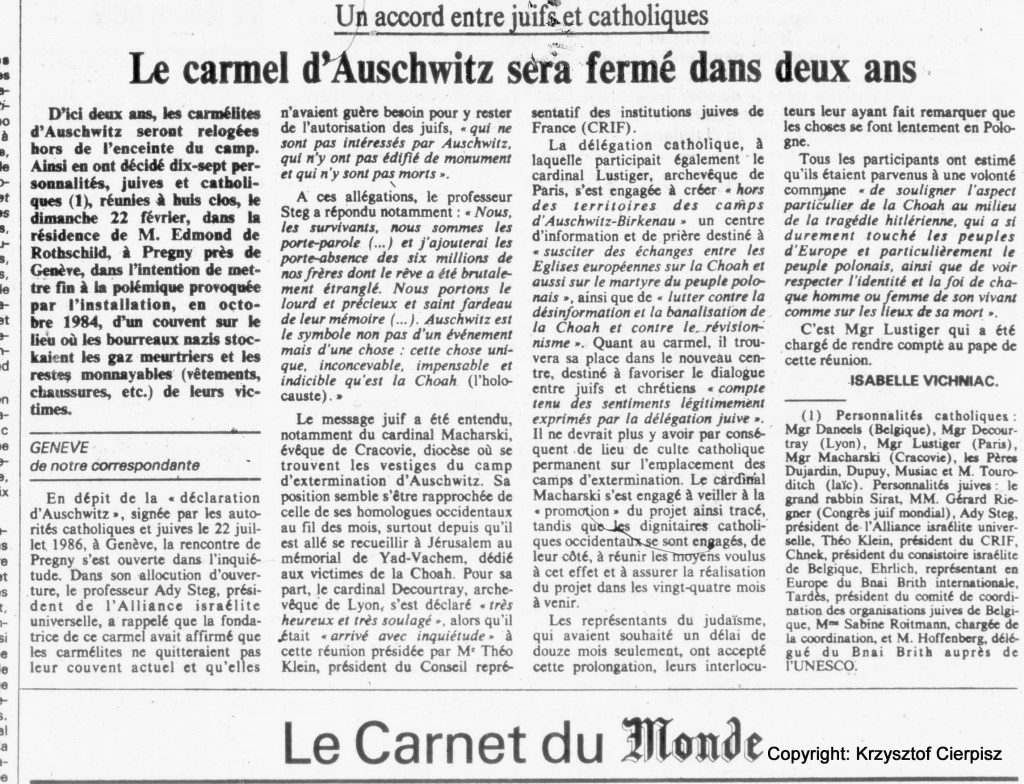
A copy of information about the Oswiecim treason. (below translation)
From today in 2 years, the Carmelite nuns from Oświęcim will be transferred outside the camp. This was decided by seventeen personalities, Jewish and Catholic, gathered behind closed doors on Sunday, February 23 at the residence of Edmund Rothschild in Pregny near Geneva, with the intention of ending the polemics caused by the installation in October 1984 of the monastery where Nazi executioners kept murderous gases and were suitable for cashing (clothes, shoes, etc.) of their victims.
Despite the "Oświęcim declaration" signed by the Catholic and Jewish authorities on 22 July 1986 in Geneva, the meeting in Pregny was opened in an atmosphere of anxiety. In a speech made by Professor Ady Steg. the president of the World Jewish Union reminded that the founder of the monastery claimed that the Carmelite nuns would not leave their present monastery and that they had no Jewish permission, as "they are not interested in Oświęcim, they did not build a monument there and they did not die there".
For these reasons, prof. Steg answered yes; "We who survived, we are spokespersons /.../ and I will add to the deputies of six million brothers who were absent, whose dreams were brutally suppressed.We lift the heavy and precious and holy burden of their memory / ... / Oświęcim is a symbol of many events, but one thing : this is something unthinkable and impossible to express what Shoah / Holokaust is.
The Jewish message was heard in particular by Card. Macharski, bishop of Cracow, and therefore the diocese within which there are remains of the extermination camp at Auschwitz. His position as if he were approaching the position of his Western counterparts in a few months, especially since he went to Jerusalem to concentrate on the Yad Vashem memorial dedicated to Shoah victims. For his part, cardinal Decourtray, Archbishop of Lyon, stated that he was very happy and very relieved, as the meeting with the chairman of Theo Klein, the president of the Council of Representatives of Jewish institutions in France - CRIF - was "disturbed".
Catholic delegation. in which also Cardinal. Lustiger, the Archbishop of Paris, pledged to create an information and prayer center outside of the Oświęcim-Birkenau area for "fueling the exchange of views between European churches on the subject of Shoah and also on the subject of Polish martyrdom" as well as "to resist the disinformation and trivialization of Shoah and against revisionism. " As for the caramel, he will find a room in a new center intended to support the dialogue between Jews and Christians, bearing in mind the feelings expressed in a justified way by the Jewish delegation. "Consequently, there should be no permanent Catholic worship in the territory of the extermination camps. he undertook to supervise the implementation of such a fixed project,
Representatives of Judaism, who demanded only the deadline of twelve months, agreed to extend, when the interlocutors pointed out to them that in Poland matters are slowly moving.
All participants of the meeting assessed that they had reached a common agreement to "emphasize" the special aspect of Shoah among the Nazi tragedy, which had so badly injured the nations of Europe, especially the Polish nation, and that the identity and faith of every man or woman were recognized during and after death. .
Card. Lustiger was obliged to take the matter to the pope of this meeting.
Izabella Vishnic
/ 1 / Catholic personalities: Card. Daneels / Belgium /, kard. Decourtray / Iyon /, kard. Lustiger / Paryź /. Cardinal. Macharski Kraków /, fathers Dujardin, Dupuy. Musiał i Turowicz / swiecki /. Jewish personalities: the great rabbi Sirat. pp. Gerard Riogner / World Jewish Congress /, Ady Steg / President of the World Israeli Union /, Theo Klein / President of CRIF, Chock President of the Israeli consistory in Belgium, Ehrlich / representative for Europe Bnai Brith international /. Tardes / president of the consultative council of Jewish organizations in Belgium /, Ms. Sabina Reitmann / obliged to coordinate / and Hoffenberg / delegate Bnai Brith at UNESCO.
Le Monde
HM .XC1995
January 11, 1987 - Jan Błoński publishes in the pages of Tygodnik Powszechny an article entitled Poor Poles look at the ghetto, in which he accuses Poles of collaborating with the Germans in the extermination of Jews.
February 22, 1987 - in Geneva there was the second meeting of the Catholic and Jewish delegation in the case of Oświęcim. Both delegations arrived in the expanded warehouse. The Catholic Church was represented by: Godfried Danneels, cardinal Albert, cardinal Jean Marie Lustiger, cardinal Franciszek Macharski, Bishop Kazimierz Górny (Kraków suffragan), Father Bernard Dupuy and Father Jean Dujardin (members of the Bishops' Commission for Dialogue with Judaism), and Fr. Stanisław Musiał SI and Jerzy Turowicz. Tullia Ze vi, Rene Samuel Sirat, Theo Klein, Marcus Pardes, Ada Steg, Sam Hoffenberg - permanent delegate of the Masonic lodge B'nai B'rith at UNESCO in Paris, Ernest Ehrlich - representative of B'nai, took part in the meeting from the Jewish side. B'rith for Europe, Gerard Riegner - representative of the International Jewish Committee for Interreligious Consultation and Georges Schnek - chairman of the Israeli consistory in Belgium. According to Bishop Górny (the current Ordinary of the Diocese of Rzeszów), who was the only one who did not sign the joint Declaration, in Geneva the point of view of one party was pushed through. In a jointly drafted Declaration, the Catholic side pledged to "create an information, education, meeting and prayer center." The second point is that the new center "will be created outside the Auschwitz and Birkenau camp areas. create a center: "fight with disinformation and banality of shoah and revisionism" "Receiving groups visiting camps to supplement their information" supporting meetings between Jews and Christians ". The most important, however, is the final part of the Declaration in which we read: "Establishment of this Center is a continuation and consistency of the commitments made at the meeting in Geneva on July 22, 1986. It assumes that the Carmelite Sisters' prayer initiative finds its place in this new context, its confirmation and its true meaning and that it will be a sign of taking into account the feelings rightly expressed by the Jewish delegation. There will be no permanent place of Catholic worship in the Auschwitz and Birkenau camp areas. Everyone will be able to concentrate here according to his own heart, his own religion and his own faith. "The fourth point is that Cardinal
February 25, 1987 - Cardinal Macharski in the short speech delivered by the Vatican Radio justified the goals of the center, he also asked the Carmelite sister for a prayer "that God bless this great intention".
On January 18, 1988 - the Provincial of the Discalced Carmelites Fr. Dominik Wider sent a letter to all members of the Carmelite Order in Poland. He wrote:
"For a long time, malicious Jewish attacks have intensified and the moral pressure of card. Franciszek Macharski to our Sisters in Oświęcim, so that they would voluntarily agree to move to another place. He argues with the love of his neighbor, not interfering in the dialogue of the Church with Jews, the recent foundation for the attack on the Holy Father and the Church in Poland. (...) I protested with Fr. Cardinal. Macharski, as well as a representative of the western side, Fr. Cardinal. Lustiger. I also appealed to NO General. I would like to inform you that almost all of Krakow's bishops are outraged at this pressure on the Sisters. Similarly, he thinks the clergy of Oświęcim and its surroundings, as well as many believers. They all think that the Sister is going wrong and that the Sisters should continue in the currently occupied monastery - their property. I am asking all our Brothers and Sisters I, II and III of the Order to pray for the sisters, that the Lord would strengthen, protect and defend them. In him, in the Immaculate Virgin of Carmel and Saint. Józef, all our hope. "
June 24, 1988 - during a visit to Austria, John Paul II supported the establishment of the center. The Pope said: "From among the many initiatives that are being undertaken in the spirit of the Council today for the Jewish-Christian dialogue, I would like to point to the information center of education and meetings that is being established in Poland."
July 26, 1988 - a cross was placed on the Gravel Pit belonging to the convent of Carmelite nuns. The initiator of the setting of the cross was Fr. Stanisław Górny, brother of the bishop of Rzeszów, Kazimierz Górny and former parish priest of St. Maksymilian Męczennik in Oświęcim. Ks. S. Górny, recalling that event, said:
"Former prisoners asked us, priests, to mark this place, outside the camp, with a symbol of the Catholic faith. The Carmelite nuns, who were already in the monastery in Oświęcim since 1984, agreed to the setting of the cross "
On January 27, 1989 , Metropolitan of Cracow Cardinal Macharski sent a special letter to the faithful in Oświęcim, in which he supported the removal of the nuns from the monastery occupied in 1984. The cardinal wrote that "the sisters will fulfill their vocation in their own new monastery, as soon as it is built in a separate area within the Center, with which the sisters will remain in spiritual communication."
February 14, 1989 - Archbishop of Lyon, Cardinal Decourtray, sent a letter to the chairman of the Council of the Representative Jewish Institutions in France and the European Jewish Congress Theo Klein. In his letter, the Cardinal apologizes to the Jewish community for failing to meet the Geneva obligations. In addition to administrative obstacles in the construction of a new monastery and Center, Cardinal Decourtray points to "difficulties related to Polish public and national opinion. In the Cardinal's letter there were also fragments offending the Carmelite nuns, who allegedly agreed to leave the monastery. The letter reads:
"Today, the sisters have accepted the decision to build a new monastery. This acceptance is of the utmost importance. The sisters settled in Oświęcim to pray for the dead. This gesture did not express any disrespect for the martyrdom of the Jewish people. At present, they irrevocably accepted the decision to transfer the monastery, understanding the intention of the Catholic Church expressed by their archbishop to respect the shoah. Through this act of obedience, they wish to contribute to the progress in relations between Jews and Catholics3 and thus fulfill the wish of the Second Vatican Council in Nostra aetate and accept the attitude to which Pope John Paul II continually calls. Finally, the Cardinal provides Jews,
March 9, 1989 - the Polish Episcopate also supported the transfer of the nuns to the new monastery. In the Episcopate's message, we read: "Polish bishops recognize the great importance of cardinal Cardinal. Franciszek Macharski's Center for Information, Education, Meetings and Prayer, which is also to include a new monastery of Carmelite nuns ".
May 17, 1989 - Senior Superiors of Men's Orders in Poland, gathered at the plenary meeting on May 16-17, 1989 in Warsaw, opposed the removal of the Carmelite nuns from the monastery. "We are deeply convinced that the monastery of the Discalced Carmelite nuns, which is their property, is in the right and proper place in our homeland and does not violate anybody's rights and harm nobody" - wrote the Higher Superiors of Men's Orders in Poland.
July 14, 1989 - six members of the Union of Jewish Students in the USA led by Rabbi Avi Weisss invaded the area of the Carmelite convent. They came with a group of journalists and a television crew. One of the witnesses to the event described this event in the following way: "Meanwhile, they (the Jews - editor of SC) started to try to balance the front door. When they did not succeed, they stopped at snapping, also jumped side fences between the courtyard and the garden, trying to get inside through the windows (barred), they also threatened with their fists, they shouted ".
July 16, 1989 - another group of Jews. "Clad in clothes imitating striped uniforms with the Star of David and this time they went through the fence, but after completing ritual prayers and calmer protests, they left the monastery area themselves. Despite the relatively peaceful course of the protest, the life of the monastery was completely paralyzed for several hours. "
July 22, 1989 - Jews from Belgium manifest in front of the Carmel building, jump over the fence, read the protest and wind in the sheep's corner.
July 22, 1989 - on the third anniversary of signing the "Zahor" declaration, Cardinal Decourtray apologized to the Jews for delays in the construction of the Center. "The Cardinal wrote in a special message: " We ask our Jewish partners to forgive us this delay caused by real obstacles from which the seriousness did not pass None of the signatories of the agreement. "
On August 8, 1989 , Cardinal Macharski issued a communique, in which he regretted the behavior of some Jewish militants conducting a "violent campaign of accusations and slanders, insulting aggression not only verbal, which moved to the area of Oświęcim." He added that "such attitudes and actions make it impossible For my further implementation of the Center, the Cardinal concludes with the words: "We stand in the position that the Church took in relation to the Jews at the Second Vatican Council, confirmed by further decisions of the Holy See"
August 11, 1989 - Cardinal Decourtray assured the Jews that "the Geneva decision will not be questioned."
August 26, 1989 - Primate of Poland, Cardinal Józef Glemp gave a homily at Jasna Góra in which he defended the Carmelite nuns. Cardinal said, among others: "Beloved Jews, do not talk to us from the position of a nation raised above all others and do not set us conditions that are impossible to fulfill. The Carmelite Sisters living next to the Auschwitz camp wanted and wanted to be a sign of this human solidarity that would embrace the living and the dead. (...) Your power is the means of social communication that are at your disposal in many countries. Let them not serve to rekindle anti-Polonism. Recently, a branch of seven Jews from New York attacked the monastery in Oświęcim, although the sisters were not murdered or the monastery was destroyed, because they were stopped, but do not call the attackers heroes. "
September 2, 1989 - Cardinal Glemp, in an interview for La Republica, defended the Carmelite nuns and expressed the opinion that the so-called Geneva agreement must be renegotiated because the people who signed it were incompetent.
September 3, 1989 - cardinals Godfried Danneels, Albert Decourtray, Jean Marie Lustiger declared that "Cardinal Glemp, when he spoke of the renegotiations of the Geneva Agreement, could only express his personal point of view. "
On September 6, 1989 - the chairman of the Episcopate Commission for Dialogue with Judaism, Bishop Henryk Muszyński issued a communiqué in which he assured about the implementation of the Geneva Declaration.
September 15, 1989 - Cardinal Glemp received Zygmunt Nissenbaum. In the message

Meeting of Primate Glemp with Zygmunt Nissenbaum (1989)
The Secretariat of the Primate of Poland wrote: "During the conversation a draft of a satisfactory solution to the Oświęcim dispute was outlined, which will be carried out by a relevant team that will take care of the implementation of the information center, education, meetings and prayer in Oświęcim."
September 19, 1989 - Chairman of the Holy See Committee for Religious Relations with Judaism, Cardinal Johannes Willebrands said that "The Holy See is ready to bring its own financial contribution to support the" construction of the Center and the new Carmelite nuns' convent "

Rabbi Joskowicz visits the Primate (1989)
September 20, 1989 - Cardinal Glemp sent a letter to Sigmunt Sternberg - chairman of the International Council of Christians and Jews, in which he assured that he wished to "keep to the terms of the Geneva Declaration of 1987 and therefore willingly enter into a dialogue between Christians and Jews."
September 21, 1989 - the chairman of the International Council of Christians and Jews Sigmunt Sternberg said: "I stated that Glemp is ready to listen"
September 29, 1989 - Cardinal Glemp wrote a letter to Zygmunt Nissenbaum in which, on the occasion of his wishes for the Jewish New Year 5750, he once again supported the construction of the Center.
22nd March 1990 - registration of the Krakow Foundation for Information, Education, Meetings and Prayer Center in Oświęcim.
November 30, 1990 -In the 25th anniversary of the Conciliar Declaration of Nostra Aetate, the Polish Episcopate published a pastoral letter stigmatizing "Polish anti-Semitism." The letter was read on January 20, 1991.
January 25, 1991 - Father General of the Order of the Discalced Carmelites, Father Felipe Sainz de Baranda wrote a letter to the superior of the Carmelite Sisters in Oświęcim, Sr. Helena Hadziewicz, in which he recommended that the sisters move to the new convent built at the Center.
September 29, 1991 - during a visit to the US, cardinal Glemp met with the Jews. Before visiting the Spertus College of Judaica in Chicago, the Cardinal stripped off his chest. Rabbi Byron L. Sherwin after the meeting with the Primate of Poland said:
"Cardinal Glemp came to us without a cross on his chest. I think that this symbolic gesture was very significant, showing the Primate's class, who did not want to offend his hosts."
April 9, 1993 - on Good Friday, John Paul II, through the bishop Tadeusz Rakoczy, wrote a letter to the Carmelite nuns in which he ordered them "from the will of the Church" to move "to another place in the same Oświęcim".
May 23, 1993 - Carmelite sisters took ownership of the existing perpetual lease.
May 24, 1993 - four sisters moved to a new monastery, built near the Center.

Carmelite convent on the day they were expelled from their own property (consecrated religious house).
Photo by Krzysztof Cierpisz.
June 8, 1993 - Maria Magiera's mother rented a monastic building for 30 years to the Association of War Victims.
June 24, 1993 - Maria Magiera's mother and the War Victims Association subleased part of the monastic building of the "Maja" Children's Village Foundation.
June 29, 1993 - attempt to take over the area of the Carmelite Sisters by the Polish authorities. The President of Oświęcim dissolved the lease contract between the monastery and the Association of Victims of War and ordered its removal of the Carmelite Sisters from the Monastery. M. Maria Magiera lodged an appeal; the court has stayed the proceedings.
June 30, 1993 - Bishop Tadeusz Rakoczy, ordinary of the Diocese of Bielsko-Żywiec, announced the desacralisation of the monastery chapel.
July 6, 1993 - the last Carmelites, together with their superior sister, left the monastery and left for the convent in Poznań.
August 8, 1993 - the superior of the Carmelite Sisters leased the monastery and grounds of Żwirowiska to the Association of War Victims.
November 21-24, 1993 - Carmelite sisters came to their new monastery in Rzeszów.
August 17, 1994 - a manifestation of Rabbi Weiss and a group of a dozen or so Jews from the United States in Oświęcim. Weiss announced that his protest was directed "only" against the Polish government, the Polish church hierarchy and the Vatican . " First, the church of Our Lady Queen of Poland in Oświęcim-Brzezinka was protested, which the Jews consider to be the former headquarters of the camp commandant. The Jews went to the former Carmelite convent, where they demanded that the papal cross be removed from the gravel yard area, and the Jews hung a banner on the fence surrounding the former monastery, saying that it was "a Jewish cemetery, not a place for the cross ". Rabbi Weiss also stated that " it is absolutely unacceptable to turn the most terrifying places of destruction into churches and to put up giant crosses."
December 22, 1994 - Provincial of the Discalced Carmelites, Father Benignus, Józef Wanat, wrote a letter to Bishop Kazimierz Nycz, in which he strongly defends the cross and property of the Carmelite nuns. Father Wanat wrote: "We have not told ourselves honestly about the most important - ideological dimension of the matter. It is organized fight for the Cross of Christ. Because of this fight, the sisters were forced to leave the Old Theater. They were urged to take the Cross with them from the place of execution of numerous Poles carried out by the Nazis. They could not do it because they considered it a betrayal of faith and the denial of the Cross in the place of martyrdom of our compatriots. I was accused of giving permission from my previous superior to lease the property to a "discredited man". I do not deny this (...). The creation of an archive in the monastery's premises was the least controversial (...). On the other hand, I could not agree at the request of the current superior to resign from religious property to the property on which the Cross stands (...). Such permission to place the land in irresponsible hands would include implicit consent to the removal of the Cross and the devotion of the enemies to the Church. For the faithful it would be tantamount to the betrayal of Christ and the denial of faith (...). I am also convinced that the nuns, in their simplicity and credulity, are manipulated and do not take into account the value and need to defend the sign of the Cross. " Such permission to place the land in irresponsible hands would include implicit consent to the removal of the Cross and the devotion of the enemies to the Church. For the faithful it would be tantamount to the betrayal of Christ and the denial of faith (...). I am also convinced that the nuns, in their simplicity and credulity, are manipulated and do not take into account the value and need to defend the sign of the Cross. " Such permission to place the land in irresponsible hands would include implicit consent to the removal of the Cross and the devotion of the enemies to the Church. For the faithful it would be tantamount to the betrayal of Christ and the denial of faith (...). I am also convinced that the nuns, in their simplicity and credulity, are manipulated and do not take into account the value and need to defend the sign of the Cross. "
December 29, 1994 - mother Maria Kądziołka asked the head of the Office of the Council of Ministers with a request to start proceedings to refund the Sisters costs incurred in the years 1984-1993 for a major overhaul old theater. The request remained unanswered.
January 25, 1995 - another protest of Raben Weiss's group in front of the Church of Our Lady Queen of Poland in Oświęcim-Brzezinka and in front of the former convent of Carmelite nuns. The Jews again demanded the liquidation of the parish church in Oświęcim-Brzezinka and the removal of the cross from Żwirowiska.
March-April 1996 - Jews unleash a dispute over the so-called a protection zone around the former camps in Oświęcim and Brzezinka. The Polish authorities are demanding that they stop the construction of shops and service outlets, and even the liquidation of all residential buildings within a radius of 0.5 km from former concentration camps.
July 4, 1996 - Nobel laureate Eli Wiesel in Poland said that "the presence of crosses on the sacred land covering countless Jewish victims in Birkenau was and remains an insult."
January 15, 1997 - mother Maria Kądziołka terminated the lease contract with the Association of War Victims, including due to non-payment of rent.
July 16, 1997 - the sisters filed an application with the Land and Mortgage Register Division of the District Court in Oświęcim to delete the entry on the lease in the land and mortgage register. By decision of the District Court, the entry was deleted, but soon this decision was annulled by the Provincial Court in Bielsko-Biała.
December 3, 1997 - crosses were removed from the site of the former German camp in Brzezinka, which had been there since 1983. They were moved to the church in Oświęcim. Józef Robotnik. The curia of the diocese of Bielsko-Żywiec and the Ministry of Culture and Art agreed to the transfer of the crosses. According to priest Romana Indrzejczyk (delegation to Katyn, editor of the Central Committee) from the parish of Baby Jesus in Warsaw, transfer of crosses from Brzezinka
Faithful of Tradition at the Gravel Pit (August 15, 1998)
"It should satisfy everyone, regardless of their beliefs. I am pleased with everything that soothes, soothes, and attempts at reconciliation. " Grzegorz Polak, a KAI journalist and a member of the Polish Episcopate Commission for Dialogue with Judaism, said: "I am glad that the matter has finally been finalized for the benefit of both sides, after many unnecessary arguments also having a resonance abroad."
February 18, 1998 - minister for contacts with the Jewish diaspora Krzysztof Śliwiński said in an interview for "La Croix" that "The Cross, at which John Paul II celebrated Mass in Oświęcim in 1979, and which is now in the former monastery Carmelite nuns, next to the concentration camp, will soon be transferred. "
March 2, 1998 - the Carmelite nuns from Oświęcim relinquished the title of the former monastery at the Auschwitz camp.
March 15, 1998 - According to minister Śliwiński, the "subject of controversy" is not "a symbol, not a cross, just 8 meters just next to the Oświęcim fence." "Does it have to be a 8-meter cross?" Asks Śliwiński.
February 19, 1998 - Minister Śliwiński revealed that the Holy See and bishop Tadeusz Rakoczy expressed consent for the transfer of the cross.
March 23, 1998 - Bishop Tadeusz Rakoczy said that he "has no idea" when he makes a decision on the cross. "I do not rule out that (...) we can and do listen in Poland, take into account the feelings of other people and possibly - what it is possible in this matter - to do "Bishop Rakoczy also assured that in the case of the cross he can" stand on each side ".
March 27, 1998 - The Polish Episcopate Committee for Dialogue with Judaism published a statement in which the Jewish "controversies about the cross in the former KL Auschwitz" were understood. We understand the sensitivity of the Jewish side and its soreness in everything concerning the reality of the symbolism of Auschwitz " in the message.
March 29, 1998 - chairman of the Episcopal Committee for Dialogue with Judaism, Bishop Stanisław Gądecki expressed his conviction that instead of a cross on the Gravel Pit, he could stand a monument with the image of the cross. He added that "this seems to be a solution that would not underestimate either Polish Christian or Jewish reasons. All other solutions will be painful for either side. "
On April 2, 1998 , the head of the prime minister's office, Minister Wiesław Walendziak, said that "if the cross - which formally stands outside the camp area - disturbs, it may soon be debatable whether churches may become available in the city of Oświęcim at all. I expect Jewish friends to respect the religious feelings of Catholics. "
April 8, 1998 - members of the Social Committee for the Defense of the Cross wrote a letter to the Primate of Poland, Ordinary of the Diocese of Bielsko-Żywiec, Bishop Tadeusz Rakoczy and Prime Minister Jerzy Buzek demanding a guarantee that the papal cross would remain. The letter remained unanswered.
April 21, 1998 - in the Gazeta Wyborcza daily Dawid Warszawski wrote: "In the experience of European Jews, Christianity has prepared the ground for the Holocaust." This cross in Auschwitz is a sign of persecutors in our eyes, not sacrifices, it insults us to put it in the cemetery of Jewish victims of Christian Europe. These words should be treated as literally as possible "Similarly, the Chief Rabbi of the Republic of Poland, Pinchas Menachem Joskowicz, said:" Jews can not pray to God when someone disturbs them, and the cross interferes with this, when I want to pray and there is a cross before me, I can not pray. "
April 24-26, 1998 - Archbishop Tadeusz Pieronek expressed doubts about the intentions of some of the defenders of the cross who, in his opinion, "use this great symbol as a fighting instrument, even with those Christians who think differently. Pieronek said:" The cross is a sign of love, forgiveness room. You can not make a symbol of conflict, dispute, fight. (...) The place of the cross in Oświęcim is its natural place. (...) But you have to respect that people who think differently, who have different theology, also died there. It is their right and their dignity that must be respected. "
3 May 1998 - Prime Minister Jerzy Buzek, who in a letter to the inhabitants of Podbeskidzie wrote that "removing crosses against the will of religious communities was a feature of totalitarian times." The Prime Minister also wrote that Bishop Rakoczy "as a host of the Diocese of Bielsko-Żywiec and a person appointed by the Head of the Church to make decisions on matters of faith and signs of faith, I do not have to fear that the government under my leadership will take actions that could in any way prejudice the Cross. Protest against the attempts to remove the cross in Oświęcim has been signed by 130 parliamentarians.
May 3, 1998 -ks Stanisław Musiał said that the Oświęcim "Cross was quietly set, in a hurry, using the underground method", and the intention of those who put it there was to "give this section of land and adjacent monastery the status of sacral immunity". In his opinion, moving the cross from Żwirowiska to another place would not "in any way desecrate this religious symbol." The Primate of Poland said that "in Oświęcim the cross stood and will stand" and that it can not be the subject of tenders, because he is among believers who have experienced the cross as salvation. "
June 4, 1998 - vice-chairman of the World Jewish Congress, Kalman Sultanik demanded that the camps in Oświęcim be extraterritorial and not subject to the authorities of the Republic of Poland. Earlier, Sultanik stated that the cross with The beginning of the Holy Mass on the Żwirowiska (August 15, 1998) The gravel pit should be moved because "Poland has promised it".
June 12, 1998 - one of the priests in Oświęcim, referring to the opinion of the Ordinary of the Diocese of Bielsko-Żywiec, suggested to the Rzeczpospolita daily that the bishop bears the intention of "moving the cross," but "there is no atmosphere to take such actions".
June 12, 1998 - the vice-chairman of the World Jewish Congress and a member of the International Council of the Auschwitz Museum, Kalman Sultanik said for the first time that "the area of Oświęcim and Brzezinka should be extraterritorial. The camps should be managed by an international committee, for example under the auspices of the UNESCO body ".
June 14, 1998 - a group of people, among others Kazimierz Switoń, made a dramatic decision to start a protesting hunger strike in the former convent of Carmelite nuns. This protest, despite as many as 42 days of duration, was almost entirely bypassed on information services.
July 19, 1998 - a picket of the Social Committee for the Defense of the Cross in front of the seat of the Bielsko-Żywiec episcopal curia in Bielsko-Biała. When the manifestation of the defenders of the cross continued under the curse, Bishop Rakoczy, when asked if the cross could be removed, he replied: "Sure, maybe!" The cross-defenders at the press conference tried to get some explanation from the bishop, they asked: "Why were removed crosses from Brzezinka under the cover of the night? " . "I will not talk to you," said the Bishop, and Bishop Rakoczy also said that in the matter of the cross, the decision was taken "A long time ago, true, during the Geneva talks, famous declarations that on the cross site a monument will be built with an element of a clear cross, true, people murdered there, so it was a matter, let's say caramel, the cross is in some sense associated with caramel ".
July 21, 1998 - priest, invited by the defenders of the cross Edward Wesołek from the Brotherhood of St. Pius X along with a group of traditional Catholics from all over Poland went to Auschwitz. Welcome, priest Wesołek led the prayers and gave a short sermon at the papal cross.
July 25, 1998 - at the request of Archbishop Kazimierz Majdanski and Bishop Zbigniew Kraszewski, after 42 days the hunger struck. Near the papal cross, the members of the Gliwice Workers' Ministry set up a 3-meter cross and 50 small ones, thus initiating the action of setting new crosses on the Gravel Quarry. The pastor of the pilgrims Father Siemiński said: "We wanted to point out that in our homeland we are the hosts and we will defend our dignity in a morally acceptable way".
July 27, 1998 - Bishop Gerard Cush from Gliwice, concerned that the pilgrims from his diocese put on gravel another cross, he said: "If the bishop was asked about the cross, this opinion would be negative." Similarly, responded Archbishop of Katowice Damian Zimoń: "It is unnecessary manipulation, these types of activities are completely alien to me. "
August 2, 1998 - Chairman of the Polish Council of Christians and Jews, Fr. Andrzej Zuberbier said in an interview with Tygodnik Powszechny that the Church "must also reckon with the other side, for whom the cross is not a sign of hope or salvation."
On August 4, 1998 - Archbishop Józef Życiński (he was a Jew and an atheist on the Central Committee) said that "Poles must realize that the Jewish theology of suffering is different from the Christian one".
On August 9, 1998 , in the pages of Tygodnik Powszechny, Father Stanisław Musiał, in sudden words, demanded the removal of the cross:
"It is time for the Church in Poland to wake up and speak out about the misuse of religious symbols for outside religious purposes (...). In fact, they are not against the Cross of Christ, who are demanding the transfer or removal of crosses from the gravel near the Auschwitz camp, but those who put those crosses there and those who are in favor of leaving them. The cross of Christ is not a clenched fist. And that's what crosses are at the gravel yard at Auschwitz. By the will of their builders and allies. Clenched fists against. "
The Association of Jewish Religious Communities believes that "actions of an anarchist nature, such as setting up crosses in the former camp without an agreement, can not bring good and should not be tolerated . " As usual, the journalist of "Gazeta Wyborcza" and "Midrasz" Dawid Warszawski has shown off his "openness and tolerance", writes that the cross "Obraża i rani, because it is clear that they were erected there for that purpose. the cross - a symbol of Christianity, whose one and a half thousand years of teaching hatred for Jews prepared the ground for the Holocaust in Europe - in a place where the doom took place, of course it would still hurt us. "
August 2, 1998 - in the communiqué of the Yad Vashem Holocaust museum, according to the Reuter agency on August 3, which was not quoted in Poland at the time, it was clearly stated: "it has been agreed that no monument will arise" ("it was agreed that tombstone would not be erected ").
August 4, 1998 - the rabbi of New York Avi Weiss announced his arrival in Poland to protest against placing on the Gravel Pit and the presence of the church next to the former camp in Brzezinka.
August 6, 1998 - Israel turned to Poland on Wednesday to take action to remove the crosses on the Gravel Pit. "The secretary of the prime minister's cabinet, Danny Naveh, asked the Polish ambassador, Wojciech Adamiecki, to try to remove the crosses in the Auschwitz-Birkenau extermination camp, which violate the nature of the place of murdering millions of Jews," declares the office of Israeli Prime Minister Benjamin Netanyahu.
August 6, 1998 - statement of Cardinal Józef Glemp on the cross. The cardinal wrote that:
"The cross is not owned by the Catholic Church, but is associated with Christianity, and as a symbol it is legible and recognized in Western civilization as a sign of sacrifice of love and suffering. Such a sign and its defense is entitled not only to the Episcopate, but to all those who accept this cross with faith. (...) The cross should stand, because here thousands of Christians died, including the Jews of Christians. This land is Polish, and any overlap of another will is perceived as an interference with sovereignty. (...) The reason for the increase in the escalation of tensions is indicated by Mr Świtoni and his group, who describes himself as the defender of the cross in Auschwitz »It must be said in the name of the truth that this band was created not out of fantasy but because of continuous and increasing harassment by the Jewish side to remove the cross as soon as possible. The initiative p. Świtonia and the people around it indicate far-reaching social emotions that can not be discharged immediately and in a radical way. (...) The case must find a positive finale on the condition that people on a one-sided solution, such as Fr. He must, will not fester with overbearing judgments. "
August 8, 1998 - the Primate's statement is disavowed by Archbishop Henryk Muszyński, who said that "the compromise solution of the case of crosses in Auschwitz is primarily a hierarchy task. We meet for this purpose at the Episcopal Conference on August 26 in Częstochowa. So for now, the papal cross is standing and will stand. I think that first you need to organize his surroundings, that is, do something with the crosses now set on the Gravel Pit as a combat instrument. "
August 10, 1998 - Holocaust museum Yad Vashem addressed a letter to President Aleksander Kwaśniewski, Prime Minister Jerzy Buzek and the Speaker of the Senate Alicja Grześkowiak in which she demanded officially transferring the crosses placed on the Gravel Quarry. "It is a provocation and violation of international agreement, according to which no religious, ideological and political symbols will be placed here" - wrote in a letter to the authorities of the Republic of Poland.
August 11, 1998 - Primate Glemp withdrew from his position on August 6. In a new statement addressed to the bishops, the Cardinal wrote:
"A few days ago I spoke about the resumption of a dialogue about the presence of the cross at the gravel yard at Auschwitz. I wanted then to pay attention to; to intensify emotions under the influence of statements from the Israeli government, ease the tensions and point to the broader level of dialogue regarding the cross. As it turned out, the statements on the part of Israel did not have the character that was initially attributed to them. The wave of emotions, however, did not decrease. On the contrary, it is growing, and not on the foundation of faith. I see two undesirable phenomena: the first is to reduce the pronunciation of the cross-symbol by adding more crosses and crosses; the second is taking over the cross-selling action often by irresponsible teams. The gravel pit loses its seriousness. I appeal to everyone interested in this matter to stop placing crosses on the gravel pit. I am asking kindly to all the venerable Brothers of Bishops; that they try to stop the growth of this non-church action. "
August 11, 1998 - Szymon Wiesenthal's center asked the Polish government to remove all crosses from the Żwirowisko area. "400,000 members of the Simon Wtesenthal Center are therefore demanding from the Polish government a quick action to restore the death camps in Auschwitz to a silent but powerful reminder of how inhuman people were to each other, and to ensure that the memory of one and a half million Jews there was no more humiliated at the place of their murder, " reads a letter addressed to the authorities of the Republic of Poland.
August 12, 1998 - six members of the House of Representatives of the US Congress sent a letter to Prime Minister Jerzy Buzek with an appeal to remove the crosses and the church from the grounds of the former concentration camp in Oświęcim-Brzezinka. The letter was the effect of the radical New York Avi Weiss.
August 12, 1998 - "Permanent solution to the problem requires respect for the right of use in places that symbolizes the tradition of the victims of Nazi repression," Prime Minister Jerzy Buzek wrote to the chairman of Miles Lerman's Council of the Holocaust Museum in Washington. This is an answer to M. Lerman's letter on the conflict for crosses on the Gravel Pit.
August 14, 1998 - chairman of the NSZZ "Solidarność" company committee in "Ursus", Zygmunt Wrzodak tries to persuade the defenders of the cross to stop the protest. To the Social Committee of the Defenders of the Cross, Wrzodak gives a signature for a draft statement in which we read that "the current defense of Saint. Krzyża (...), was a success. "Kazimierz Switoń claims that " Wrzodak was sent by some Bishop. "
August 15, 1998 - Primate Jozef Glemp in a sermon on Jasna Góra, said that in the case of the crosses in Auschwitz, "the Episcopate will do nothing to offend evangelical love and justice to the murders of Nazi innocent citizens of many countries . " the honor and love of Poles to their homeland, respecting the rule of law in the solidarity of all nations and the rules of partnership dialogue. "
August 15, 1998 - in Oświęcim, on the feast of the Assumption of the Blessed Virgin Mary, on the 78th anniversary of the "Miracle on the Vistula" priests from the Society of Saint Pius X celebrated Holy Mass and placed the second largest cross (after the papal cross) on the Gravel Quarry. Father Karl Stehlin sacrificed all the new crosses on the Gravel Pit.
August 17, 1998 - Jan Turnau in Gazeta Wyborcza beats the alarm: "To the defenders of the cross joined the Lefebvrists, or opponents of the Pope." "Gazeta Wyborcza" on the 1st, 2nd and 4th page is slandering the Society of St. Pius X, at the same time opposing him to the " Brotherhood of Saint Peter " in communion with Rome.
August 18, 1998 - several dozen Rabbis of Israel turned to the Holy Father with the message that his authority would support efforts to resolve the conflict over the Auschwitz crosses. The chief rabbi of Poland, Pinchas Menachem Joskowicz, states that the site of the former Auschwitz-Birkenau camp should be extraterritorial.
August 19, 1998 - District Office in Oświęcim on Wednesday, the Association of War Victims signed a lease contract for the site of the former Żwirowisko camp in Oświęcim. Since 1993, the Association has been leasing the Żwirowiska area, owned by the State Treasury. A press spokesman of the State Protection Office has publicly admitted that the UOP undertook operational activities regarding the conflict over the Auschwitz crosses.
August 22, 1998 - the American organization "Shalom International", which gathers over 500 Jewish organizations from 16 countries, called for an international boycott of Poland.The president of this organization, Bob Knust, wrote: "Our international boycott, directed against abusive attacks on our 'saint the land is created by all those who have been affected by terrible politics, trivialization, revisionism and attempts to 'Christianize and' Vaticanize the Holocaust '
August 23, 1998 - the weekly Wprost warns against the Society of Saint Pius X, which "would gladly take over the structures and supporters of Radio Maryja".
August 23, 1998 - priest Karl Stehlin gave an interview to "Tygodnik Siedlecki" about the conflict around Oświęcim, when asked why the Society of Saint Pius X decided to put his cross on the gravel yard , said: "Leaving the cross symbolizes support for defending the symbol of our religion, which in this the accident is the so-called papal cross, it is an expression of our will to defend the Catholic faith, which is, in our opinion, threatened by the removal of very important signs inseparably connected with the identity of the Polish nation. "
August 25, 1998 - Cardinal Józef Glemp and Prime Minister Jerzy Buzek talked about the crosses in Oświęcim, at the headquarters of the Secretariat of the Polish Bishops' Conference in Warsaw. "The government and the Episcopate have a common view on how to resolve the conflict in Oświęcim," said Minister Wiesław Walendziak.
25- August 26, 1998 - the Permanent Episcopate Council met in Jasna Góra. The Council is composed of: Primate Józef Glemp, vice-chairman Archbishop Henryk Muszyński, Secretary General of Bishop Piotr Libera and cardinal Franciszek Macharski, Archbishop Tadeusz Gocłowski, Archbishop Józef Michalik, Archbishop Juliusz Paetz, Archbishop Damian Zimoń, Archbishop Józef Życiński, Bishop Alfons Nossol and Bishop Kazimierz Ryczan. The action of putting crosses on the gravel pit was taken without the consent of the proper diocesan bishop or even against his will. Both primate priest and bishop of the place and other bishops called for dialogue and respect for other beliefs, " states the statement of the Permanent Polish Episcopate Council, where the bishops also state that it is arbitrary to put crosses on the gravel yard. "It has the signs of provocation and is not consistent with the seriousness due to this special place. " "The action organized in this way reconciles both the memory of the murdered victims and the good of the Church and the nation, and painfully hurts the different sensitivity of our brothers Jews" - they write in a statement episcopal. "Let your attachment to the cross be expressed in the reverent activities indicated by the ecclesiastical authority," the bishops call in. They also express confidence that the newly placed crosses will find a worthy place in our parishes and temples. bishops write that the church "Is connected with the Jewish people by special signs of spiritual heritage. The Episcopate Council also asked the Jews in" the name of God Abraham, Isaac and Jacob, who for us Christians is also God of Jesus Christ for continuing the dialogue, "together shed the blood of our Fathers and Forefathers, Brothers and Sisters ,; it has helped us to let the name of God be glorified together. "
August 26, 1998 - in spite of the statement of the Permanent Episcopate Council, another 4 crosses were placed on the Gravel Pit. Archbishop Muszyński announced that on September 14, on the feast of the Exaltation of the Cross, expatriation services for misunderstanding the theology of the cross will take place in Polish churches.
August 26, 1998 - "Poles can not be deprived of the right to commemorate their martyrs in a manner consistent with their faith and tradition," wrote the head of the Prime Minister's Chancellery Wiesław Walendziak in a letter to six US Congressmen who sent a letter to the Prime Minister on the crucifix on 12 August. that the Auschwitz-1 camp, next to which the cross stands, was intended mainly for Poles, emphasizing that on the Żwirowiska, in a place outside the camp, the Nazis shot 152 Poles in 1941. Walendziak also stood in defense of the church adjacent to the wall of the former camp He pointed out that the Jews had no objections to the church's location during its construction or at the time of the consecration in 1985. "Demolition of the parish church for over 5,000 Brzezinka residents would be unacceptable not only for Poles, but also for Catholics around the world, regardless of their nationality, " said Minister Walendziak, recalling that the government of Jerzy Buzek removed the crosses and Stars of David set there by scouts from the area of the former camp.
August 27, 1998 - Prime Minister Buzek attempted to influence the court's decision to take away the Żwirowiska lease from the War Victims' Association. Jerzy Buzek said: "I believe that the court realizes that it is necessary to act quickly, because the judges are also citizens of our country."
August 27, 1998 - "There is no Christianity without a cross, but we must learn and respect the sensibilities of others. Deep catechesis is needed to understand the point of view of the Jews. In Poland, it is simply not understood, " said Archbishop Henryk Muszyński, the Archbishop of the Episcopate, and, according to Archbishop Józef Życiński, not only the reactions of Jewish communities, but some Catholics are a big problem. "We are not optimistic if after our roll call the radio, which is called the Catholic one, calls for putting crosses on the gravel pit. We only hope that this communication will help to clarify the situation. On the one hand, we have a clear voice of bishops, and on the other, skinheads, Lefebvts, who invite people to the cross on the Internet, we have former employees of the SB who have earned merit in international scandals. I believe that for many people the choice will be clear, " said Archbishop Zycinski, and the annual Catholic Pastoral Lectures began at the Catholic University of Lublin. During the inauguration, Archbishop Życiński warned against a false understanding of radicalism. ".Radiclicts appear in ecclesiastical environments, and some of them defend the cross against bishops. Lefebvres even defend their faith against the Holy Father, " said Archbishop Życiński.
August 28, 1998 - the participants of the conference of the International Council of Christians and Jews (ICCJ), which took place in Erlbach, Germany, expressed their appreciation for the position of Polish bishops. In a special resolution, the representatives of 28 national and local Christian-Jewish organizations from around the world emphasized at the same time that in their understanding the "big cross that has been there since 1989" was to be moved by the transfer of the monastery to the building near the position of Polish bishops who spoke leaving the papal cross in the same place, removing the remaining crosses and continuing the dialogue between Jews and Christians, met with a "very positive" reaction of the World Jewish Congress. Kalman Sultanik, who is the vice-president of this organization, said on Wednesday in New York that the call of Polish bishops "is a very important step forward that will enable the continuation of the Polish-Jewish dialogue." Satisfaction with the Episcopate's decision was expressed by the Vice-President of the Israeli Parliament Shevah Weiss (Shevah Weiss) : "This is a very important declaration and I hope that people will remove private crosses that look like provocation." According to Weiss, it would be best for the papal cross to make world Jewish organizations talk to the Pope himself. "But the Pope was there and we have sympathy for this Pope, we know what a humanist is and what he did as a young man to save Jews too " Weiss said. The Jerusalem Institute of National Remembrance Yad Vashem demands removal of all crosses from the Gravel mine, although the decision on the Episcopate is a positive sign for the future and an expression of good intentions of the Polish side. "We also demand the transfer of the papal cross. International agreements stipulate that no symbols of an ideological, political or religious nature may be placed in the camp. This applies not only to crosses, but also to the stars of David, " said Yas Vashem director Avner Szalew. Menachem Pinchas Joskowicz, Chief Rabbi of Poland, commenting on the position of the Permanent Polish Episcopate Council regarding the Oświęcim crosses declared that " it is unsatisfactory ".
August 28, 1998 - President of the Republic of Poland Aleksander Kwaśniewski believes that the prolongation of the conflict around the crosses at the Żwirowiska gravelight in Oświęcim is ruining a good image of Poland in the world. During a press conference in Krakow, the president stressed that the conflict should be resolved quickly and "in the spirit of respect for the dignity of Poles, Jews and all victims of the tragedy of the Auschwitz crime". "I hope that common forces through persuasion, as well as administrative actions taken by the government we will manage to settle the matter, " said Kwasniewski. The President said that he very much appreciates the statement of the Polish Episcopate in this matter. "I consider them an event of great importance. The unambiguity of this statement is really of great importance, "he said.
August 29, 1998 - Cardinal Glemp justifies the removal of the crosses from the gravel pit in that they were not duly consecrated. The Primate's statement was reported by the daily "Life", writing: "No one devoted these crosses to these crosses, but he emphasized that worthily sacred crosses will be defended by the Church everywhere . " In this way, the Primate commented on the dedication of all new crosses by Fr. Karl Stehlin from the Brotherhood of St. Pius X on August 15.
August 29-30, 1998 - "Gazeta Wyborcza" in the column "Yesterday read" publishes a fragment of the article titled There will be a valley of crosses placed in No. 23 "Always Faithful." And "Tygodnik Powszechny" publishes an article by Jan Nowak Jeziorański. The cross and the wall of crying. The famous "Kurier from Warsaw" wrote that "A pilgrimage to the Auschwitz schism of the priesthood brotherhood" of Archbishop Marcel Lefebvre and the setting up of the cross on the Gravel Quarry has its unusual meaning. Lefebvre and his "brotherhood" excommunicated John Paul II in 1988 ".
30 August 1998 - priest Karl Stehlin celebrated the Tridentine Mass for the victims of World War II under the papal cross at the Gravel Field in Oświęcim. In the Mass. almost 300 faithful participated. After Mass, the Mass of Trent in the Gravel Pit (August 30, 1998) Fr.. Stehlin sacrificed all the new crosses set at the Gravel Pit.
On August 30, 1998, the public television and commercial stations inform about the Trent Mass at the Gravel Pit. The main edition of Panorama is dedicated to the Brotherhood for several minutes. Dr Piotr Mazurkiewicz from the Academy of Catholic Theology. He said that the Society of Saint Pius X "is not a part of the Roman Catholic Church, and in Poland is a marginal group and, suggesting a lack of unity between bishops and faithful, tries to use the situation to be able to exist in the social consciousness."
August 31, 1998 - the press informs about the Trent Mass, which was celebrated on the Gravelyard on August 30 by Fr. Karl Stehlin. Jacek Żakowski wrote in the Gazeta Wyborcza that "the Oświęcim action" is directed "in fact not so much against the Jews as against the secular society and the Church modernizing itself in the spirit of the Vatican Council 77." In his opinion, "on the horizon of this dispute is clearly visible an attempt to create an integrist folk Church operating independently of canonical structures. "
August 31, 1998 - Archbishop Józef Życiński, commenting on the sermon of Fr. Karl Stehlin during Mass. at Żwirowisko, he announced that "Fr. Stehlin chose the path of late Marxism . "
September 1, 1998 - Archbishop Tadeusz Pieronek described the attitude of the Brotherhood of Saint Pius X as "typically sectarian." Commenting on the Sunday Mass celebrated at the Papal Cross in the Gravel Quarter by Father Karl Stehlin, Bishop Pieronek said: "events that have place around the Oświęcim crosses, they are a very pathetic picture of the whole matter, which has been clearly defined by all the presidents of the Church Concordat Committee, said that not only the Lefebry but also others will be gathering on the gravel, so that "hyenas get their position" content of Father Stehlin's sermon, " Archbishop Pieronek said that it only testifies to the fact that "Steblin does not know the structure of the Episcopate and does not know who is authorized to speak . " Archbishop Henryk Muszyński, however, recognized the sermon of priest Karl Stehlin as "the purest form of demagogy . " Archbishop Muszyński, to somehow discredit the Brotherhood of St. Pius X , he consciously appealed to the Polish-German resentments. " In his opinion, " a German priest takes actions that - regardless of the declarations - clearly affect both the Church and the nation. "Any comment is simply unnecessary," added Archbishop Muszyński.
September 2, 1998 - Deputy Minister of Foreign Affairs of the Republic of Poland Radosław Sikorski said during a press conference at the Polish embassy in Tel Aviv that crosses at the gravel yard in Oświęcim "are made by extremists who have been condemned both by state and church authorities. The whole affair is provoked by the Lefebvrists. "
September 2, 1998 - Diocesan Curia in Drohiczyn expressed solidarity with the position of the Council of the Permanent Episcopal Conference regarding the Oświęcim crosses. The Curia has no doubts that "the papal cross should remain where Poles perished, but that" the politicization of the case by extremists on both sides arguing for the Cross is an abuse of the sign of our salvation, a symbol of love and reconciliation ".
September 3, 1998 - Ewa K. Czaczkowska writes in "Rzeczpospolita": "It is already evident today how the conflict on the gravel yard is won by the Lefebvre." Only a few in Poland have heard about the Priestly Society of St. Pius X, and even less about his presence in our society. On Sunday, all of Poland saw how priest Karl Stehlin celebrates Mass on the gravel pit and criticizes Catholic bishops. "It is not without reason that Bishop Pieronek did not hesitate to compare the actions of the Lefebvre to the hyenas who feed on the conflict to wrest something for themselves. crosses by Father Stehlin raises the question: who do they belong to now and where should they be transferred? "
September 6, 1998 - the weekly Wprost writes about the "Antykościół" in the article entitled " Schismatics from the Brotherhood of Saint Pius X." According to the magazine, "hundreds of thousands" and maybe even "millions of faithful" Catholics in Poland "is closer to schismatic Archbishop Marcel Lefebvre than to John Paul II ".
September 7, 1998 - in front of the Gravelyard in Oświęcim, priest Adolf Chojnacki celebrated Mass. for about 100 people. In his sermon, Father Chojnacki appealed to the Holy Mass celebrated on the Gravel Hill by the Society of Saint Pius X. He said that the Sunday mass was held before the Gravel Pit, because "the land on which the papal cross stands has been desecrated by schismatics last week".
September 8, 1998 - "Bulletin of the Catholic Information Agency" reported that "Bishops from Central and Eastern Europe, gathered at a meeting in Frisis, expressed their solidarity with Archbishop Józef Życiński, slanderously named by priest Karl Stehlin 'the main enemy of the cross in the Polish Episcopate (...) 'To be German, come to a camp in which the Germans murdered Poles, and here in their place of death to persuade Polish Catholics to disobey their bishops is the greatest audacity that can happen - said one of the German hierarchs to Father Stehlin ".
September 10, 1998 - Archbishop Tadeusz Pieronek said that the "whole storm" around the Oświęcim cross caused an "unhappy" statement by Minister Krzysztof Śliwiński (Government Plenipotentiary for Dialogue with the Jewish Diaspora). Śliwiński said in the spring that the decision to transfer the papal cross from Żwirowiska was already made. According to bp. Piero, Kazimierz Świtoń, Polish Lefebricists and Jewish milieus - "little by little" - are responsible for causing and escalating the conflict around Żwirowiska.
September 11, 1998 - the great rabbi of France, signatory of the so-called Geneva agreements Rene Samuel Sirat said that the papal cross "in respect of the word" should be transferred from Auschwitz.
September 12, 1998 - Archbishop Józef Życiński said in an interview:
"I recently read in a letter from a retired professor that John Paul II betrayed the Catholic tradition, which the supporters of Lefebvrey defend. We find an even greater grotesque in the translations of priest Stehlin, who explains with a high necessity, that he had to perform a mass for the faithful at Auschwitz. As if we did not have priests in Poland. "
September 13, 1998 - priest Karl Stehlin gave another interview to "Tygodnik Siedlecki." Fr Stehlin said that "there would be no problem of Oświęcim crosses if the Church were to stand by the old Tradition". Speaking of the crosses on the Gravel Pit, Fr. Stehlin recalled the dispute over Karmel Oświęcim: "After all, under the pressure of Jewish communities, not only the sisters but also the Blessed Sacrament were removed! It is only now that this is what Bishop Rakoczy said about the 'Geneva Agreement' signed by Cardinal Lustiger, cardinal Macharskiego and red. Turowicz, a clause on the removal of the papal cross was included.
September 14, 1998 - more crosses were placed on the Gravel Pit. One of them was funded by priest prelate Ryszard Król from Kępice near Słupsk. Under the papal cross, Fr. Tadeusz Dzięgiel - Wołynowicz celebrated Holy Mass In the sermon of priest Dzięgiel - Wołynowicz said that "the hierarchical church has significantly departed from the Gospel." Speaking of the defense of the crosses in Auschwitz, the priest referred to the sermon of Father Edward Wesołek on August 15, he said: "This is Westerplatte, we have nowhere to go back. but on Polish laws. "
September 15, 1998 - the ordinary of Kielce, Bishop Kazimierz Ryczan, criticized the organizers of the action at the Gravel Pit. He regretted that for the first time the holy sign of faith was used to divide Poles. The bishop also said that the Jews do not stand to see the cross in Oświęcim, because they did not meet with the cross. "They do not want to meet the cross, they despise the cross, they do not see the sense of suffering. For them, Szoah oświęcimski is just annihilation - a dark and empty tragedy prepared for people by people. The senselessness of suffering leads to despair. Such attitudes are led by Satan. The cross restores the sense of suffering, which is why it is hated. This one can understand who has met the cross " - bishop Ryczan said. At the same time, the bishop pointed out that the new crosses are brought by unbelievers, infidels and falsely impersonating the names of others - "this is not a novelty, so it was at Calvary two thousand years ago. Satan will always find his followers. "
September 27, 1998 -ks prelate Ryszard Król from Kępice near Słupsk, who set a cross on the gravel yard on September 14, was punished with annual leave by bishop Marian Gołębiewski, ordinary of the Koszalin-Kołobrzeg diocese.
September 29, 1998 - "The case of the crosses does not stop worrying the Poles, insulting Jews, making world opinion. This is all the more astonishing that the transfer of crosses agreed bishops " - said in a letter to Prime Minister Jerzy Buzek: Jan Błoński Joseph Gierowski, Czeslaw Milosz, Wladyslaw Strozewski, Wislawa Szymborska and Jerzy Turowicz. In their opinion, the " defenders of the cross sparkle also people with a criminal past, apparently striving to stir up quarrels and disorder in Oświęcim and all Poland . ""Time to put an end to it, do not hide behind unnecessary procedures. The government is responsible for the order in the state, "they wrote, significant that these" intellectuals "of the communist past (Cz. Miłosz was an employee of the Polish Embassy in Paris after the war, and W Szymborska wrote peanyes in honor of" just ideology " write about" criminal past "defenders of the cross.
prepared by Sławomir Cenckiewicz (supplemented by photographs and short comments by Krzysztof Cierpisz 2011-11-29)
Edition 06-XII-2014 Gazeta Warszawska
Edition 10-II-2019 Gazeta Warszawska
Edition 19-IV-2019 Gazeta Warszawska
https://sites.google.com/site/krzysztofcierpisz/kalendarium-konfliktu-oswiecimskiego
Original in Polish:


