
The first Israeli Prime Minister has ordered the destruction of a Hizbollah weapons warehouse in Beirut with a new weapon. The weapon, which is not well known, caused considerable damage in the city, killing more than 100 people, injuring 5,000 and destroying many buildings. This time it will be difficult for Benjamin Netanyahu to deny it.
- On September 27, 2018, Benjamin Netanyahu pointed out to the United Nations General Assembly forum the warehouse that will explode on 4 August 2020 as a Hezbollah arms depot.
The first Israeli Prime Minister, Benjamin Netanyahu, authorized a strike against a Hezbollah arms depot using a new weapon that has been tested for seven months in Syria. It is not known whether the second Prime Minister, Benny Gantz, gave his consent.
|
x
|
Izrael niszczy Wschodni Bejrut nową bronią
Pierwszy izraelski premier nakazał zniszczenie magazynu broni Hezbollahu w Bejrucie za pomocą nowej broni. Broń, która nie jest dobrze znana, spowodowała znaczne zniszczenia w mieście, zabijając ponad 100 osób, raniąc 5000 i niszcząc wiele budynków. Tym razem Benjaminowi Netanjahu trudno będzie temu zaprzeczyć.
- 27 września 2018 roku Benjamin Netanjahu wskazał na forum Zgromadzenia Ogólnego ONZ magazyn, który eksploduje 4 sierpnia 2020 roku jako skład broni Hezbollahu.
Pierwszy izraelski premier Benjamin Netanjahu zezwolił na strajk na skład broni Hezbollahu przy użyciu nowej broni, która była testowana przez siedem miesięcy w Syrii. Nie wiadomo, czy wyraził zgodę drugi premier Benny Gantz.
Do strajku doszło 4 sierpnia 2020 r., Dokładnie w miejscu wskazanym przez Benjamina Netanjahu w przemówieniu do ONZ z 27 września 2018 r. [ 1 ].
Nie wiadomo, jakiej broni użyto. Jednak był już testowany w Syrii od stycznia 2020 r. Jest to pocisk z taktycznym komponentem nuklearnym w swojej głowicy, który wywołuje grzyb dymny charakterystyczny dla broni jądrowej. Nie jest to oczywiście bomba atomowa w sensie strategicznym.
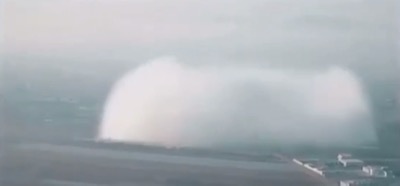
- Izraelski test w Syrii.
Broń została przetestowana w Syrii na równinie na wsi, a następnie w Zatoce Perskiej na wodzie przeciwko irańskim okrętom wojskowym. Po raz pierwszy zastosowano go w środowisku miejskim, w szczególnym środowisku, w którym podmuch powietrza i wibracje odbijają się od wody i gór. Daleki od zniszczenia tylko portu w Bejrucie, zabił około stu osób, zranił co najmniej 5000 innych i w dużej mierze zniszczył wschodnią część miasta (część zachodnią w dużej mierze chronił silos zbożowy).
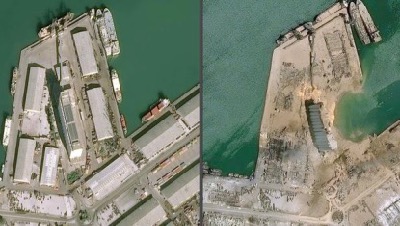
- Te zdjęcia satelitarne pokazują zniszczenie magazynu Hezbollahu i części portu.
Izrael natychmiast uruchomił swoje sieci w międzynarodowych mediach, aby ukryć swoją zbrodnię i uwiarygodnić ideę przypadkowej eksplozji zapasów nawozów. Jak to często bywa, wymienia się fałszywych winowajców, a międzynarodowa machina medialna w kółko powtarza to kłamstwo bez jakiegokolwiek dochodzenia. A jednak rzeczywiście istniał komin niezgodny z tezą o eksplozji nawozu.
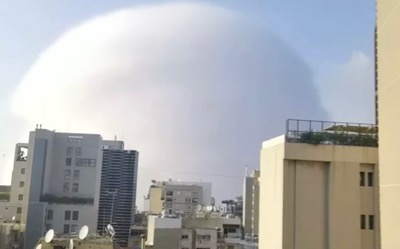
- Grzyb dymny obserwowany w Bejrucie nie ma nic wspólnego z tym, co spowodowałby konwencjonalny materiał wybuchowy.
Tak jak ani Syria, ani Iran nie poinformowały o tej broni, kiedy zostały trafione, libańskie partie polityczne natychmiast osiągnęły porozumienie, że nic nie mówią, aby nie demoralizować swojej ludności. Wszczęto dochodzenie nie w sprawie przyczyny wybuchu, ale odpowiedzialności personelu portu za przechowywanie nawozu rzekomo odpowiedzialnego za wybuch. Jednak to kłamstwo szybko obróciło się przeciwko partiom politycznym, które sobie to wyobrażały.
Trybunał Narodów Zjednoczonych dla Libanu, który miał upublicznić swój werdykt w sprawie zabójstwa byłego premiera Rafika Haririego w 2005 roku, postanowił odroczyć go o kilka dni. Identycznie w tym przypadku eksplozja pickupa maskowała wystrzelenie pocisku z nową bronią, tak jak tym razem eksplozja azotanu maskowała wystrzelenie pocisku z inną nową bronią.
Pięć lat później, pięć lat za późno, ujawniłem w rosyjskim magazynie sposób, w jaki zginął Rafik Hariri [ 2 ], podczas gdy Hezbollah opublikował wideo potwierdzające zaangażowanie Izraela.
Należy zauważyć, że zamach w 2005 roku wymierzony był w byłego sunnickiego premiera, a atak w 2020 roku nie był wymierzony w szyicki Hezbollah, ale w cały libański ruch oporu.
Tym razem kilka ambasad przeprowadziło ankiety, w tym pobranie próbek ziarna i filtrów powietrza z karetek, które natychmiast udały się na miejsce zdarzenia. Są już badane w swoich krajach.
The strike was carried out on August 4, 2020, at the exact location designated by Benjamin Netanyahu in his speech to the United Nations on September 27, 2018 [1].
It is not known what weapon was used. However, it has already been tested in Syria since January 2020. It is a missile with a tactical nuclear component in its warhead that causes a smoke mushroom characteristic of nuclear weapons. It is obviously not an atomic bomb in the strategic sense.
- Israeli test in Syria.
The weapon was tested in Syria on a plain in the countryside and then in the Persian Gulf on the water against Iranian military vessels. This is the first time it has been used in an urban environment, in a particular environment that made the air blast and vibrations reflect off the water and the mountains. Far from destroying only the port of Beirut, it killed about a hundred people, injured at least 5,000 others, and largely destroyed the eastern part of the city (the western part was largely protected by the grain silo).
- These satellite photos show the destruction of the Hezbollah warehouse and part of the port.
Israel immediately activated its networks in the international media to cover up its crime and lend credence to the idea of the accidental explosion of a fertilizer stockpile. As is often the case, false culprits are named, and the international media machine repeats this lie over and over again in the absence of any investigation. Yet there was indeed a smokestack incompatible with the thesis of a fertilizer explosion.
- The smoke mushroom observed in Beirut has nothing to do with what would have been caused by a conventional explosive.
Just as neither Syria nor Iran had communicated about this weapon when they were hit, the Lebanese political parties immediately reached an agreement not to say anything in order not to demoralize their population. An investigation was opened, not into the cause of the explosion, but into the responsibility of the port’s personnel for the storage of the fertilizer allegedly responsible for the explosion. However, this lie soon turned against the political parties that had imagined it.
The United Nations Tribunal for Lebanon, which was due to make public its verdict in the case of the assassination of former Prime Minister Rafik Hariri in 2005, decided to postpone it for a few days. Identically in that case, the explosion of a pickup truck masked the firing of a missile with a new weapon, just as this time the explosion of nitrate masked the firing of a missile with another new weapon.
Five years later, five years too late, I revealed in a Russian magazine the manner in which Rafik Hariri had been killed [2], while Hezbollah published a video attesting to Israel’s involvement.
It is important to note that the 2005 assassination targeted a former Sunni Prime Minister and that the 2020 attack targeted not Shiite Hezbollah, but the Lebanese Resistance as a whole.
This time, several embassies carried out surveys, including taking grain samples and air filters from ambulances that immediately went to the scene. They are already being examined in their respective countries.


