
NA POKŁADZIE SAMOLOTU AIRFOREX ONE — Prezydent Donald Trump powiedział w sobotę, że chciałby, aby Jordania,
Egipt i inne państwa arabskie zwiększyły liczbę uchodźców palestyńskich przyjmowanych ze Strefy Gazy
— potencjalnie umożliwiając wysiedlenie wystarczającej liczby ludności,
aby „po prostu oczyścić” obszar ogarnięty wojną i stworzyć praktycznie czystą kartę.
+
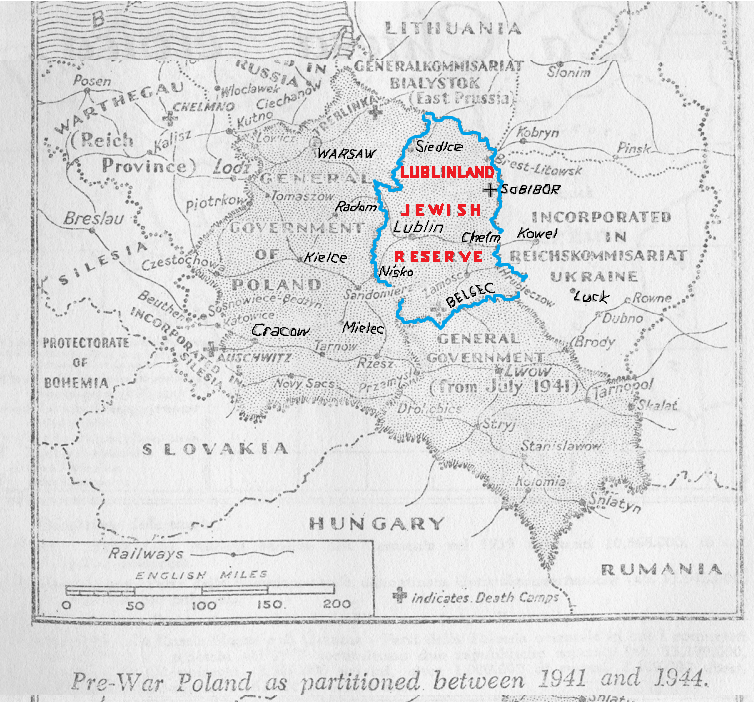
Gaza ma być oczyszczona z Palestyńczyków tak, jak Polska miała być posprzątana z Polaków. Hitlerowcy czyścili Lubelszczyznę z Polaków, to pod „państwo żydowskie w centrum Polski”.
Dla Trump'a Palestyńczycy nie są ludźmi i trzeba ich posprzątać, to właśnie tak samo jak dla hitlerowców Polacy również nie byli ludźmi, a których też trzeba było posprzątać.
Hitlerowcy sprzątali Polaków, aby w wyczyszczonej Polsce, dać przestań żydom, a Trump teraz kopiuje te ludobójcze metody na Palestyńczykach w Gaza`zie — sprząta.
Dla nas nauka jest prosta, a przerażająca, to nie jest tylko historia — żydowskie sprzątanie, czyszczenie Polski z Polaków trwa do 17 września 1939 roku, a Gaza to tylko etap.
Red. Gazeta Warszawska
+
Jędrzej Giertych: A JEWISH STATE IN CENTRAL POLAND?(Judaism & Islam)A
JEWISH STATE IN CENTRAL POLAND ? ENGLISH summary By Jedrzej Giertych Acc “Komunikaty Tom II cz. I 1979/1980
https://sites.google.com/site/krzysztofcierpisz/ajewishstateinpoland
http://gazetawarszawska.eu/2012/11/18/zydy-w-polskim-radio-za-polskie-pieniadze/ ...Created on 14 February 2018
|
NA POKŁADZIE SAMOLOTU AIRFOREX ONE — Prezydent Donald Trump powiedział w sobotę, że chciałby, aby Jordania, Egipt i inne państwa arabskie zwiększyły liczbę uchodźców palestyńskich przyjmowanych ze Strefy Gazy — potencjalnie umożliwiając wysiedlenie wystarczającej liczby ludności, aby „po prostu oczyścić” obszar ogarnięty wojną i stworzyć praktycznie czystą kartę. Podczas 20-minutowej sesji pytań i odpowiedzi z reporterami na pokładzie Air Force One w sobotę Trump powiedział również, że zakończył kontrolę swojego poprzednika nad wysyłaniem 2000-funtowych bomb do Izraela. To podnosi punkt nacisku, który miał zmniejszyć liczbę ofiar cywilnych podczas wojny Izraela z Hamasem w Strefie Gazy, która została teraz zatrzymana przez kruche zawieszenie broni. „Wypuściliśmy je dzisiaj” – powiedział Trump o bombach. „Czekali na nie od dawna”. Zapytany, dlaczego zniósł zakaz dotyczący tych bomb, Trump odpowiedział: „Ponieważ je kupili”. Trump zbudował swoją karierę polityczną wokół bezkompromisowego pro-Izraela. W kwestii swojej szerszej wizji Gazy Trump powiedział, że wcześniej tego dnia rozmawiał z królem Jordanii Abdullahem II i w niedzielę porozmawia z prezydentem Egiptu Abdelem Fattahem el-Sisim. „Chciałbym, żeby Egipt przyjął ludzi” – powiedział Trump. „Mówisz o prawdopodobnie półtora miliona ludzi, a my po prostu wyczyścimy to wszystko i powiemy: »Wiesz, to koniec«”. Trump powiedział, że pochwalił Jordanię za pomyślne przyjęcie palestyńskich uchodźców i powiedział królowi: „Chciałbym, żebyś przyjął więcej, bo patrzę teraz na cały Strefę Gazy i to jest bałagan. To prawdziwy bałagan”. Tak drastyczne przesiedlenie ludzi otwarcie zaprzeczałoby palestyńskiej tożsamości i głębokiemu związkowi z Gazą. Mimo to Trump powiedział, że część świata obejmująca Gazę „miała wiele, wiele konfliktów” przez stulecia. Powiedział, że przesiedlenie „może być tymczasowe lub długoterminowe”. „Coś musi się wydarzyć” – powiedział Trump. „Ale to dosłownie teraz miejsce rozbiórki. Prawie wszystko jest zburzone, a ludzie tam umierają”. Dodał: „Więc wolałbym zaangażować się w niektóre państwa arabskie i budować domy w innym miejscu, gdzie być może będą mogli żyć w pokoju dla odmiany”. Biuro premiera Izraela Benjamina Netanjahu nie udzieliło natychmiastowego komentarza. Trump w przeszłości przedstawiał niekonwencjonalne poglądy na przyszłość Gazy. Zasugerował po swojej inauguracji w poniedziałek, że Gaza „naprawdę musi zostać odbudowana w inny sposób”. Nowy prezydent dodał wtedy: „Gaza jest interesująca. To fenomenalne miejsce, nad morzem. Najlepsza pogoda, wiesz, wszystko jest dobre. To tak, jakby można było tam zrobić kilka pięknych rzeczy, ale jest bardzo interesująca”. Tymczasem jego wznowienie dostaw dużych bomb jest zerwaniem z ówczesnym prezydentem Joe Bidenem, który wstrzymał ich dostawy w maju, aby powstrzymać Izrael przed rozpoczęciem całkowitego ataku na południowe miasto Gazy, Rafah. Miesiąc później Izrael przejął kontrolę nad miastem, ale po tym, jak zdecydowana większość z 1 miliona cywilów, którzy mieszkali lub schronili się w Rafah, uciekła. „Cywile ginęli w Gazie w wyniku tych bomb i innych sposobów, w jakie atakują centra populacji” – powiedział Biden CNN w maju, gdy podniósł broń. „Wyraźnie powiedziałem, że jeśli wejdą do Rafah... nie dostarczę broni, która była historycznie używana do radzenia sobie z Rafah, do radzenia sobie z miastami, które radzą sobie z tym problemem”. Wstrzymanie działań Bidena spowodowało również zatrzymanie 1700 bomb o wadze 500 funtów, które zostały zapakowane w tę samą przesyłkę do Izraela, ale bomby te zostały dostarczone kilka tygodni później. Działanie Trumpa następuje po tym, jak świętował on pierwszą fazę zawieszenia broni między Hamasem a Izraelem, która wstrzymała walki i umożliwiła uwolnienie niektórych zakładników przetrzymywanych przez Hamas w Gazie w zamian za setki palestyńskich więźniów przetrzymywanych przez Izrael. Negocjacje dotyczące trudniejszej drugiej fazy umowy, która ostatecznie doprowadziłaby do uwolnienia wszystkich zakładników przetrzymywanych przez Hamas i trwałego wstrzymania walk, jeszcze się nie rozpoczęły. Rząd Izraela zagroził wznowieniem wojny z Hamasem, który 7 października 2023 r. rozpoczął masowy atak na Izrael, jeśli pozostali zakładnicy nie zostaną uwolnieni. |
Arc. KSC2005/02 In this little work the author formulates the hypothesis that there was a plan in some Zionist circles during the Second World War to achieve not only the political aim of a Jewish state in Palestine, but also another political aim: the establishment of a similar state in Poland (in the province of Lublin); and that in this endeavour the Jewish politicians initially had some support on the part of Hitler, or at least of some German government circles at the time of Hitler’s rule. The matter needs more thorough examination in archives and the author is not in a position now to undertake such an examination. But the general lines of the problem present themselves sufficiently clearly in the light of scattered information, accessible in works which have been already printed. The author (gathered together in this work this information in the form of excerpts; from printed works (many of them in the English, or German language, all quoted in the original, but always with, an added Polish translation). All the texts quoted have been carefully examined and interpreted by the author. It is am indisputable fact that in 1939 and in 1940 the German occupation authorities in Poland were organizing a. “Jewish Reserve” in the province of Lublin in Poland and according to some-German pronouncements, this , Re-serve” was to contain the whole Jewish population of Poland and probably also the Jewish population transferred from other countries, such as Germany, Czechoslovakia and Austria. As according to an official estimate there were 3.351.000 Jews in Poland on 32st August 1939 (3.136.000 according to the official census of 1931), the transfer of the total Jewish population of Poland into the Lublin province would have created, even without the transfer of Jews from abroad, an accumulation of Jewish population twice as large as the present total population of the Republic of Israel and roughly equal to the total population of such independent states as Denmark, Norway, Finland, Eire or Syria.
The German transfer of groups of Jewish population from other Polish provinces and from abroad into the Lublin province and expulsions of the Polish population from this province actually took place but they were on a small scale. This however is easy to explain because of the difficulties of war time. There is however another sign which supports the opinion, that the German I government considered the plan of a Jewish Reserve in a serious way. The total Jewish population in Poland was transferred by the German authorities into “ghettoes” in larger Polish cities and towns and in these ,,ghettoes”, enclosed by walls, ordered to perform industrial work for the German Army and undoubtedly suffering great economic and physical persecution the Jews were allowed to achieve one very important thing: some elements of political self-government (a Jewish administration, police, tax system, school system, prisons, courts, public welfare etc.) which was preparing them for future statehood. In the administration of the “ghettoes”, the German authorities found a large class of enthusiastic supporters among the Jews themselves. It is impossible to dismiss this fact by the statement that they were quislings and traitors. It is obvious, that they were Jewish patriots, that they believed in the usefulness and importance of their work for the Jewish cause and that they seemed to work according to a common political plan, undisclosed, but clearly perceptible in their attitude. They were not perturbed by the oppressive character of the German rule and calmly conducted their work until a very late date. When they discovered that the Germans were aiming at the massacre of the Jewish population — and for a long time they did not want to believe this — they almost all found a patriotic death, either by suicide or by volunteering to the” gas chambers, or by German execution. The Jewish “ghettos” became a step on the way, leading to German massacre, but they could easily have become also a step towards a Jewish state on Polish soil. The transfer of the Jews into the “ghettoes” destroyed the former basis of the Jewish economic existence In Poland as a scattered population of traders, merchants, artisans, workers and professional men. The years of life in isolated, purely Jewish communities under a harsh German rule, in poverty, in hard work and in a system of Jewish self-government, had also transformed them psychologically and made of them a human material better suited to the future role of Zionist settlers. After the war the “ghettoes” would have been opened. The transfer of their population into a newly created, purely Jewish province with an agricultural basis, would have been an almost obvious solution. Contrary to opinions expressed by some at the quoted sources, the Lublin province was one of the richest and most fertile provinces of Poland. The city of Lublin had centuries old historical traditions in its local Jewish community and was, during the epoch of Jewish dispersion, one of the main historical centres of Jewish life, similar to Toledo, Amsterdam and Wilno. It is the author’s opinion, that in 1939 and in 1940 the creation of a Jewish state or “reserve” in the Lublin province was a serious German aim. In summer 1940 the Germans begun to have doubts, and in 1941 dropped the plan altogether. The plan of a massacre of the Jews was not an original German aim, but was conceived only in or after 1941, in connection with some general change in German political plans. The abandonment of the German plan of a Jewish Reserve in Lublin may perhaps be connected in some way with the breakdown of German-Soviet political co-operation in the years 1939-1941. The reason why the German Nazi government, known for its anti-Semitism, may have wanted to create a Jewish territory which sooner or later would have to become a Jewish state can be explained by the fact that they were prepared to use any means which would help to destroy Poland. A question which it is impossible to answer without an examination of archives, is the problem if there were in 1939 or at any other time -an formal agreements, concerning the Lublin Reserve, between the German government and any responsible Jewish political circles. It seems to the author, that there must have been some such agreement. The author quotes long excerpts from a remarkable book by one of the most prominent Jewish politicians, the leader of the influential party of the Zionists-Revisionists, the late V. Jabotinsky, in which the idea incessantly recurs, that it was an aim of the Jewish nation to establish MORE THAN ONE Jewish state after the end of the Second World War. It needs not be said, that a plan, involving the expulsion of a several million strong Polish population from the Lublin province and an establishment of a Jewish state there, would have been a terrible shock for Poland. Such a state would have immediately been taken under the protection of Soviet Russia and it would have also enjoyed sympathies in the Anglo-Saxon world. In the centre of Poland a strong, alien body would have been established and this could have been for Poland almost a death blow. There is no justification whatsoever for accession of Polish territory for Zionist ends. Poland is not the homeland of the Jews. She has given hospitality to the Jews for many centuries and besides Spain she was the main country outside Palestine in which they found a temporary home. But it would have been ingratitude on the part of the Jews to repay Poland for her hospitality by territorial aggression. It is the widespread opinion in England and America that during the between — the — wars period of 1918-1939 the prevailing attitude of the Polish nation towards the Jews was anti-Semitism. It will not be out of place here to say a few words about this for benefit of the English or American reader. This opinion is completely unjustified, because the Polish-Jewish conflict of that time had a purely political character and did not differ from any other political conflict between nations, such, as the Polish-German, or English-Irish, or Italian-Yugoslav, or Greek-Turkish. What was the so called Polish anti-Semitism, is best shown by the fate of Jan Mosdorf, one of most prominent of its leaders, whose name resounded in the thirties throughout the world for this reason. During the second world war the Germans placed him in a concentration camp, where he joined an underground group, which for motives of Christian charity, was organizing help for the Jews, who were the most persecuted among the Inmates of the camp. His activities were discovered by the Germans and he was executed for this. I would say, this is not the most typical attitude for an anti-Semite: to give his life for persecuted Jews. The so-called Polish anti-Semitism was not directed against the Jews as a. race, but against the Jews as a political power, whose aims were opposed to the Polish ones. There is much similarity between the Jewish-Arabic political opposition in Palestine between the wars and the Jewish-Polish in Poland of the same time. The Arabs also were not anti-Semites: it would be ridiculous to call them by this name if only for the very simple reason that they were Semites themselves. They were opposed to the Zionists not because they did not like Semites, but because they saw in them a danger to the Arab national cause and to their country. The Jews were, in Poland, a force which was not negligible even numerically. Talk that a Jewish state could be created on Polish territory did not start only in 1939: such talk was widespread already many years earlier, not, it is true, in connection with the province of Lublin, but with the province of Polesie, which since the Russo-Ger-man agreements of 1939 has been In the Russian zone of Poland. (This province, which included the towns of Pinsk and Brest, was an immediate neighbour of the province of Lublin). The number of Jews in Poland was sufficiently large to form a viable in-dependent state. The Polish Jews were ardent Nationalists and it was they who were to create the Zionist Republic in Palestine. (With the exception of Herzl, all the most important leaders of Zionism were Jews from the territory of ancient Poland and the bulk of Zionist settlers and stragglers came from Polish territory too). They were a tremendous economic and financial power in Poland and this power was increased (by their ties with Jewish communities abroad. Their political attitude was to a great extent hostile to Poland. A very substantial part of the Jewish proletariat and intelligentsia in Poland sympathised with Soviet Russia and helped the Russian side in the Polish-Russian war of 1919/20; the Communist Party in Poland was to a great extent composed of Jews and even to-day people of Jewish origin form a very numerous and influential part of the Communist administration in Poland. The religious, liberal and wealthy sections of Polish Jewry before, during and after the First World War sympathized with Prussia, with Imperial Germany, with the Austro-Hungarian Empire, and with the German Weimar Republic. Those Jews who took part in Polish political life often undisguisedly showed their hostility to Poland; e.g. Mr Isaac Grunbaum, the leader of the Jewish representation In the Polish Parliament (which was quite numerous thanks to the Polish proportional electoral system), conducted a policy of (permanent alliance with the Nazi representation of the German minority in Poland and with Ukrainian separatists, with the aim of a transformation of Poland into a Polish-Jewish-German-Ukrainian federation, in which the predominantly Polish character of Poland would disappear. In notorious utterances in the Polish Parliament in 1919 he made threats that (Poland would lose Gdansk , Wilno, Lwow and Silesia if she would not comply with some Jewish demands. He later became one of the most prominent leaders of Zionism and a member of the Government of the Republic of Israel.) Te facts quoted above should be sufficient to prove that Polish-Jewish antagonism was mainly a political one. This antagonism was increased by the fact that many persons of Jewish origin became nominal Christians In Poland, and were superficially assimilated into the Polish nation, but were in fact atheists and cosmopolitans and exercised a disruptive influence in the life of Polish society, whose basis is essentially Catholic. One must also remark, that in past centuries the Jews enjoyed in Poland an exceptional amount of liberty, never known to such extent in other countries. It was a part of Poland s political philosophy that nobody should be persecuted for his faith and that unbelievers should not be compelled to become Christians if they do not wish to. (The most coherent exposition of this philosophy was made by the Polish thinker of the XVth century, Paulus Vladimir, but this philosophy permeated practically the whole of Polish history from the XIIIth century till modern times). Poland has never known religious intolerance and never known religious persecution. ( The sufferings of the Jews in the Polish Ukraine in the XVIIth century were not the fault of Poles but of the Cossack rebels, who mutinied against Poland). At the time when the Jews suffered persecutions and massacres in Germany and many other countries and were completely expelled from such countries as Spain and England, great crowds of Jews from all European countries sought refuge in Poland and found it there. Polish tolerance and hospitality became the cause of a mass immigration of Jews into Poland and of the birth of the extraordinarily numerous communities of Polish Jews. In the period of Poland’s partitions (1772-1918) the predominant section of Polish Jews found it expedient to make arrangements with Poland’s ‘oppressors (Prussia, Russia and Austria), and to dissociate itself from the Polish cause. The Jews helped to spread the German and the Russian language in Poland in many Polish cities: they started to speak Russian, to support the Russian theatre, the Russian press, the Russian schools etc. in such cities as Wilno, Pinsk, Bialystok and to some extent even Warsaw, and in the same way they started to speak German in-Poznan and to some extent in Cracow and Lwow. They supported the Prussian and Austrian governments in Western and, Southern Poland and the Russian revolutionary parties in Eastern and Central Poland. Having the support of Poland’s oppressors, who, according to the principle divide et impera tried to transform them into a factor counterbalancing the native Polish population,. they became during the XlXth century a tremendous economic and political-power in Poland and started to consider themselves as co-owners of the Polish territory. This was the source of their program to organize in Poland a purely Jewish province, into which the bulk of Polish Jewry could be transferred. A good example of the Increase of Jewish influence in Poland is the fact that in Poland’s capital city, Warsaw, they formed 4.5 p.c. of the population in 1781, in the time of Poland’s independence, and 33.9% in 1857 under Russian rule. In the second largest Polish city, Lodz, 5.7% in 1793, 31.8% in 1897 and 40.7% in 1910.
+++
It seems that there was also a plan to organize a third Jewish territory in the Crimean Peninsula of Southern Russia and in adjoining districts. A large scale agricultural Jewish colonization was conducted there at the beginning of Soviet rule and several “autonomous Jewish districts” were organized there. It is the opinion of the author that the real programme of at least some of the Zionist circles before and during the Second World War was to create not only one Jewish state (in Palestine), but two, or perhaps even three. The simultaneous existence of two or three Jewish states, in the Middle East, in Central Europe and perhaps also in Southern Russia, would have given the Jewish nation a much greater weight in world politics than at present. These plans came to ruin in consequence of the sudden change of German policy and of the terrible massacre of the Jews, executed by Hitler in the last years of the Second World War. Only a relatively small fraction of Polish Jewry was saved (partly thanks to the disinterested and often heroic help of the Poles) and was able to contribute its substantial effort to the building of the Republic of Israel in Palestine.
Written n1956
A Jewish State in Poland
Jedrzej Giertych
|

https://www.npr.org/2025/01/26/g-s1-44831/trump-jordan-egypt-accept-more-refugees-just-clean-out-gaza


